

‘Proclaim liberty throughout all the land’

America 250 — Part Two
In the news series
Jewish Family Education with Candace R. Kwiatek, The Dayton Jewish Observer
How Jews Advanced Freedom in Revolutionary America. Happy 250th, America! A Brief History of Jews and Religious Freedom in the USA. Jewish Values, American Ideals: A Shared Legacy of Liberty.
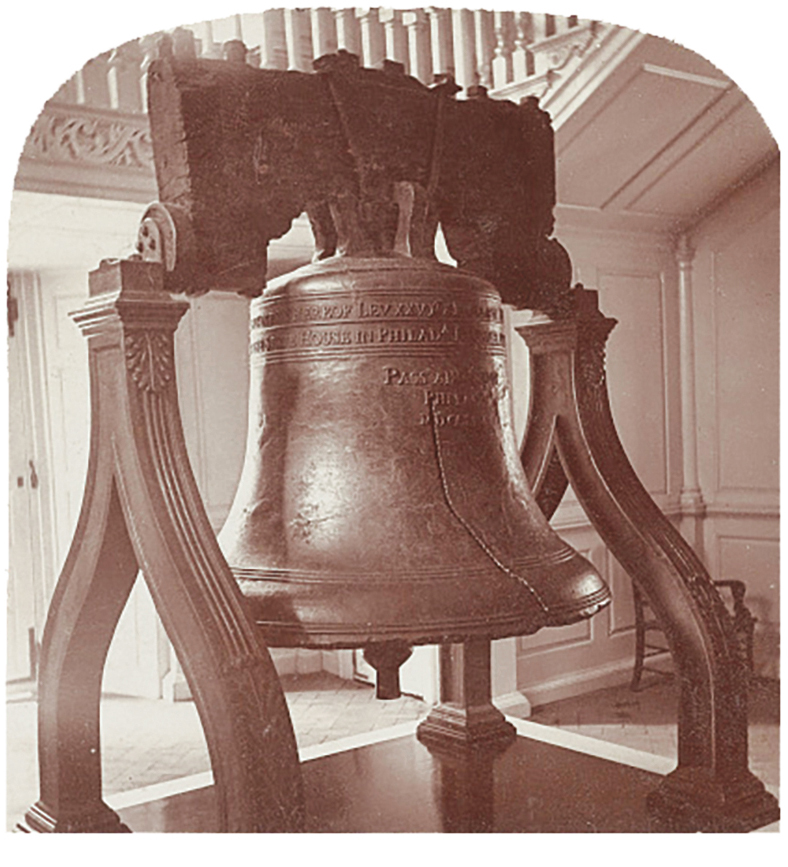
One of America’s most iconic symbols of freedom, the Liberty Bell has unexpectedly deep Jewish roots. Long before it became a symbol of American independence, the Pennsylvania Assembly commissioned the bell to commemorate the 50th anniversary of William Penn’s 1701 Charter of Privileges.
Deeply influenced by the Hebrew Bible, this remarkably progressive constitutional document established revolutionary religious and civic freedoms, legal protections, and property rights that reflected a civic application of biblical ideas. Nearly a century later, this charter would serve as an ideological blueprint for America’s founding documents.
Tasked with the bell project was Isaac Norris, a Quaker who “loved Hebrew so deeply that he owned the largest collection of Hebrew books in the colonies,” writes Hebrew educator Inbal Amit. “When he searched for the words to ring out over a new land, he did not reach for Greek or Latin or even English. He reached back to the Hebrew Bible.”
To honor the historic milestone, Norris turned to Leviticus 25:10, “And you shall hallow the 50th year,” a verse that introduces the biblical Jubilee — a sacred, 50-year cycle commanding the release of indentured servants and the restitution of property.
For Norris, the core promise of the Jubilee perfectly mirrored the spirit of William Penn’s legacy: the abolishment of subjugation and elevation of human dignity.
To capture these parallel visions, Norris selected the definitive command of the Jubilee to encircle the bell’s bronze crown, forever linking Penn’s 50-year accomplishment to the eternal biblical decree: “Proclaim LIBERTY throughout all the Land unto all the inhabitants thereof.”
Yet, the Liberty Bell is far more than a monument to a past event. Its inscription serves as an ongoing challenge to America and its people, evoking the foundational archetype of liberty: the Exodus.
It calls our nation to measure its liberty against the biblical standard — a redemptive journey from physical liberation to psychological transformation and covenantal responsibility.
This journey began when the enslaved Israelites were freed from their forced labor and subjugation to Egypt’s Pharaoh. After crossing the Sea of Reeds, they were free from their former constraints — a state of raw, unformed independence known as chofesh.
Yet, while the Israelites were no longer enslaved, they lacked intrinsic purpose and direction, leaving them exposed to the risks of anarchy.
Breaking external chains was just the beginning. The journey to true freedom required them to leave behind basic independence and embrace deeper dimensions of liberty found in the biblical concepts of dror and cherut.
Rooted in the biblical Jubilee, dror represents structural emancipation — a state of true liberty where individuals are no longer subjugated and can reclaim their rightful place in society. Through the return of land to its original owners and the liberation of all debt-bonded slaves, dror restored both ancestral heritage and personal dignity. This framework granted individuals the self-determined autonomy to live, work, and flourish without artificial boundaries or economic subjugation.
Yet even structural liberty can decay into narrow self-interest without a moral compass. To address this, a third Hebrew concept of liberty emerges: cherut. While the word does not appear in the Bible, it became a cornerstone of rabbinic Judaism to define ultimate freedom. Rather than viewing law as an external restraint imposed by societal forces, cherut represents a state in which the moral law is entirely internalized.
The sages of the Talmud illustrated this idea through brilliant wordplay in the Mishnah. Discussing the Ten Commandments engraved (charut) on the stone tablets, they read the word not as charut, but as cherut (freedom).
The sages concluded the only truly free person is one who internalizes moral and spiritual wisdom so deeply it becomes engraved upon their heart.
True freedom is not merely the absence of external chains, but the internalization of moral and intellectual purpose. This profound truth was ultimately intuited by the Israelites at Mount Sinai. True liberation is neither the absence of a master nor the license to ignore rules, but a voluntary dedication to righteous principles.
By willingly accepting the commandments, the Israelites discovered the path to authentic freedom: moral perspective, self-governance, and responsible action aimed at reaching humanity’s highest potential.
The Israelite journey from Egypt to Sinai serves as a timeless mirror for the American experiment, tracing a fragile evolution that continues to unfold today. America’s founding generation successfully secured chofesh — the vital but raw independence from a distant crown. But a nation left only with chofesh risks decaying into factionalism, where absolute license and self-interest replace the common good.
To safeguard this fragile independence, the Founders constructed a constitutional architecture of dror. They built a structural framework of natural rights, checks and balances, and institutional protections designed to prevent tyranny and grant individuals the autonomy to flourish. Yet dror remains incomplete; American history proves systemic liberty requires constant moral willpower to defend and expand.
Today, amid deep polarization, contemporary America confronts its ultimate biblical challenge: the realization of cherut. True freedom cannot be outsourced to courts, policed by external forces, or guaranteed by wealth. It requires cherut — the daily practice of internal moral self-mastery. In a modern democracy, cherut is the civic conscience that compels citizens to balance individual rights with communal responsibilities, proving that a free society cannot survive on the absence of restraint alone.
The Liberty Bell’s inscription doesn’t celebrate a static historical achievement. It issues an ongoing prophetic demand. It calls upon every generation of Americans to move beyond the raw independence of chofesh, continuously perfect the legal landscape of dror, and engrave the moral responsibility of cherut onto the fabric of their hearts. Only then does liberty cease to be a fragile political experiment and become an enduring spiritual reality.
Literature to share
The Jewish World of Alexander Hamilton by Andrew Porwancher. This eye-opening biography and fast-paced detective thriller explores the possibility that Alexander Hamilton’s West Indies upbringing shaped his lifelong mission to champion Jewish civil rights in America. Determined to make the egalitarian rhetoric of the American Revolution a reality, Hamilton fought for Jewish equality in court and shattered barriers, revealing how deeply Jewish history is woven into the American founding. Based on extensive primary sources across the Caribbean and Europe, it’s for history buffs and general readers.
Saving Lady Liberty: Joseph Pulitzer’s Fight for the Statue of Liberty by Claudia Friddell. This inspiring, engaging historical picture book for elementary ages brings a lesser-known chapter of U.S. history to life. Through vivid storytelling and captivating artwork, it chronicles how a famed immigrant newsman in the 1880s launched one of America’s first crowdfunding campaigns to underwrite the iconic monument’s pedestal. Informative and inspiring, it beautifully highlights how ordinary citizens and schoolchildren, rich and poor alike, came together to save an American symbol of freedom. Featuring beautiful, vintage-style artwork that brings the historical era to life, the book also includes extensive back matter.
To read the complete August 2026 Dayton Jewish Observer, click here.