

‘Seek the welfare of the city’

America 250 — In the news series
Jewish Family Education with Candace R. Kwiatek, The Dayton Jewish Observer
Jews, Judaism, and the American Founding. The Jewish Impact on the Founding of America. Meet the Jews who played pivotal roles in American history.
There is a common misconception that the Jewish American story began with the massive migration waves of the late 19th and early 20th centuries. This era often conjures vivid images of the estimated 2.5 million Eastern European Jewish immigrants fleeing recurrent pogroms, crushing poverty, and political persecution.
Crowding ships’ rails and spilling down wooden gangplanks, they packed the tenements of New York’s Lower East Side, creating the most densely populated neighborhood on earth.
Similar scenes played out in smaller numbers but with equal intensity in Boston, Philadelphia, Baltimore, and even Galveston, Texas.
The reality is that Jews were deeply woven into the fabric of early America long before steamships arrived.
Their presence dates back to 1492 when, to escape the Spanish Inquisition, the multilingual converso Luis de Torres (born Yosef ben HaLevi HaIvri) joined Christopher Columbus on his first voyage.
Certain he would encounter traders and diplomats in Asia who spoke Hebrew, Aramaic, and Arabic, Columbus welcomed de Torres as his interpreter. At least five other conversos were also part of the crew, and some historians believe Columbus himself shared their ancestry.
After months of exploring the Caribbean, Columbus went back to Spain, while de Torres stayed behind with about three dozen sailors tasked with building a fort at La Navidad on Hispaniola (present-day Dominican Republic and Haiti).
Upon his return many months later, however, Columbus found that infighting and an attack by local tribes had wiped out the whole garrison.
Today, de Torres is remembered as the Americas’ first Jewish resident, described by Forward culture reporter P. J. Grisar as “a refugee of faith…the first of the pilgrims.”
Despite the tragic fate of Hispaniola’s earliest European pioneers, the Caribbean became a sanctuary for conversos in the 1500s.
Although the Spanish Crown had strict prohibitions against “New Christians” and those with Jewish ancestry settling in the Americas, thousands migrated there anyway.
Among them was Hernando de Castro, who arrived in Cuba in the 1520s.
When many of the settlers abandoned Cuba for the mainland in search of gold, the island’s population shrank and its economy floundered.
Seeking to reverse these declines, de Castro sent a direct petition to the King of Spain in 1543 for approval to construct a sugar cane mill, which de Castro eventually built.
This initiative provided a vital economic lifeline, laying the groundwork for Cuba’s foundational role in the 16th-century Caribbean sugar boom.
These two stories of early pioneers highlight vastly different ways of encountering a new land.
The experiences mirror the prophet Jeremiah’s directive to the exiled Israelites in Babylon: “Seek the welfare of the city to which I have exiled you…for in its prosperity you shall prosper.”
At La Navidad, Luis de Torres’ contingent ignored this call. Instead of building relationships, they treated the indigenous population as servants and property, triggering a violent backlash that destroyed the garrison.
Conversely, Hernando de Castro embodied Jeremiah’s call to invest in the common good. Rather than exploiting or abandoning Cuba, he sustained it by establishing a vital sugar mill, tying his personal future to the island’s survival. He clearly demonstrated that the well-being of the Jewish Diaspora was inextricably linked to the prosperity of their new home.
Jeremiah’s imperative took root on the North American mainland through countless pioneers who dedicated their talents, resources, and labor to the common good.
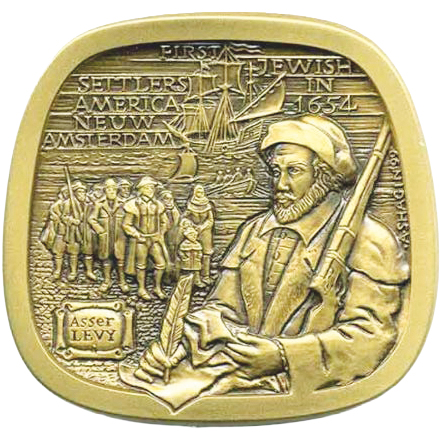
The 1654 refugees: Arriving destitute in New Amsterdam from Recife, Brazil, where under new Portuguese rule the Inquisition was reemerging, 23 Jewish refugees fought Director-General Peter Stuyvesant’s opposition by promising to contribute capital and labor.
Winning the right to stay, they propelled forward the notion of religious tolerance in the colonies while linking New Amsterdam to major Caribbean and European commercial hubs.
Asser Levy: When New Amsterdam barred Jewish residents from the volunteer burgher (citizen) guard, Levy successfully petitioned for the right to military service, proving public safety is a shared civic duty.
His continued advocacy for his Jewish compatriots secured more rights for others as well — citizenship, property and business ownership, and trade — laying the groundwork for broader ethnic tolerance.
Abigail and Abraham Minis: Arriving in Savannah in July 1733, the Minis family anchored the fragile, newly founded Georgia frontier. By developing land, establishing merchant networks, and securing critical trade supplies, they wove themselves into the permanent economic fabric of the American South.
Aaron Lopez: A Portuguese religious refugee, Lopez transformed Newport into a powerhouse of international trade. He built a massive shipping fleet, established whale oil manufacturing, and became the town’s highest taxpayer by the early 1770s, funding vital civic spaces and public infrastructure.
From the Caribbean to the North American mainland, these and other early American Jews transformed Jeremiah’s ancient directive into a tangible reality.
They did not merely seek shelter; they actively sought the welfare of the cities that reluctantly received them. Their enduring legacy challenges us today to take note of their example, reminding us that our own future remains deeply bound to how well we invest in the common good.
Next month: Let freedom ring!
Literature to share
A Promised Land: Jewish Patriots, the American Revolution, and the Birth of Religious Freedom by Adam Jortner. This exceptionally readable and timely work delivers a lively, story-driven look at how early Jewish citizens shaped the nation’s founding. It immediately hooks the reader with fascinating biographical vignettes and engaging chapters like The Rabbi of the Revolution and The Jew Bill. Seamlessly blending rigorous research with the pacing of a great storyteller, A Promised Land completely refreshes our understanding of early American life and liberty.
The Boston Chocolate Party by Tami Lehman-Wilzig and Rabbi Deborah R. Prinz, illustrated by Fede Combi. This delightful picture book weaves together the history of the American Revolution and Sephardic Chanukah traditions for readers ages 5 to 9. Through a story of friendship and resilience, it serves as a delicious and inspiring way to introduce children to a lesser-known chapter of American colonial history. It also includes valuable end notes featuring detailed historical summaries about Sephardic settlers and authentic recipes for colonial hot chocolate and traditional buñuelos.
To read the complete July 2026 Dayton Jewish Observer, click here.