
7 (possibly 8) Jewish Civil War veterans are buried at Dayton National Cemetery.
Here are their stories.
By Marshall Weiss, The Dayton Jewish Observer
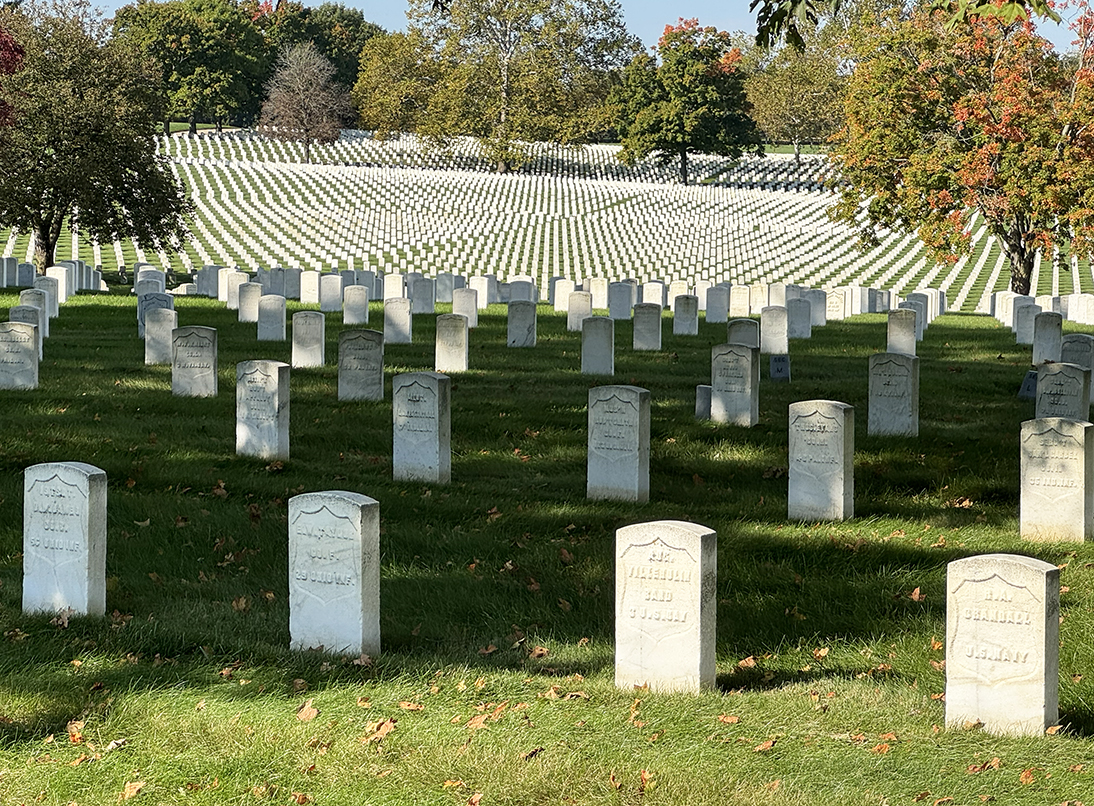
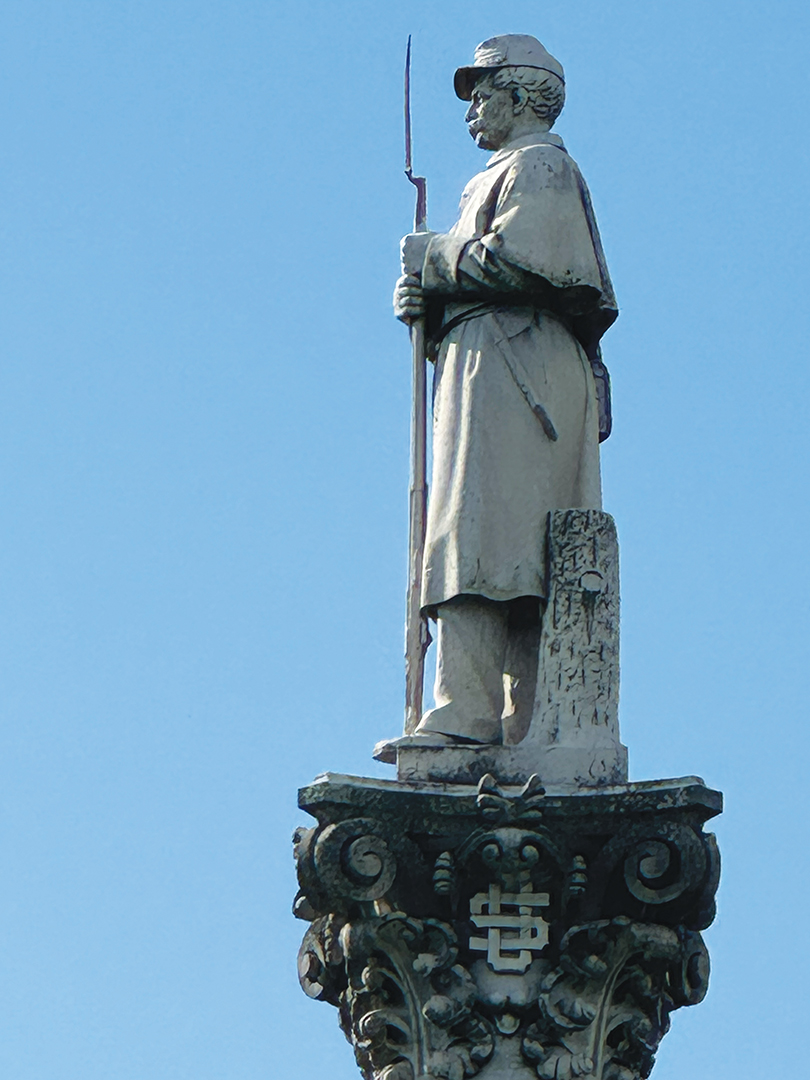
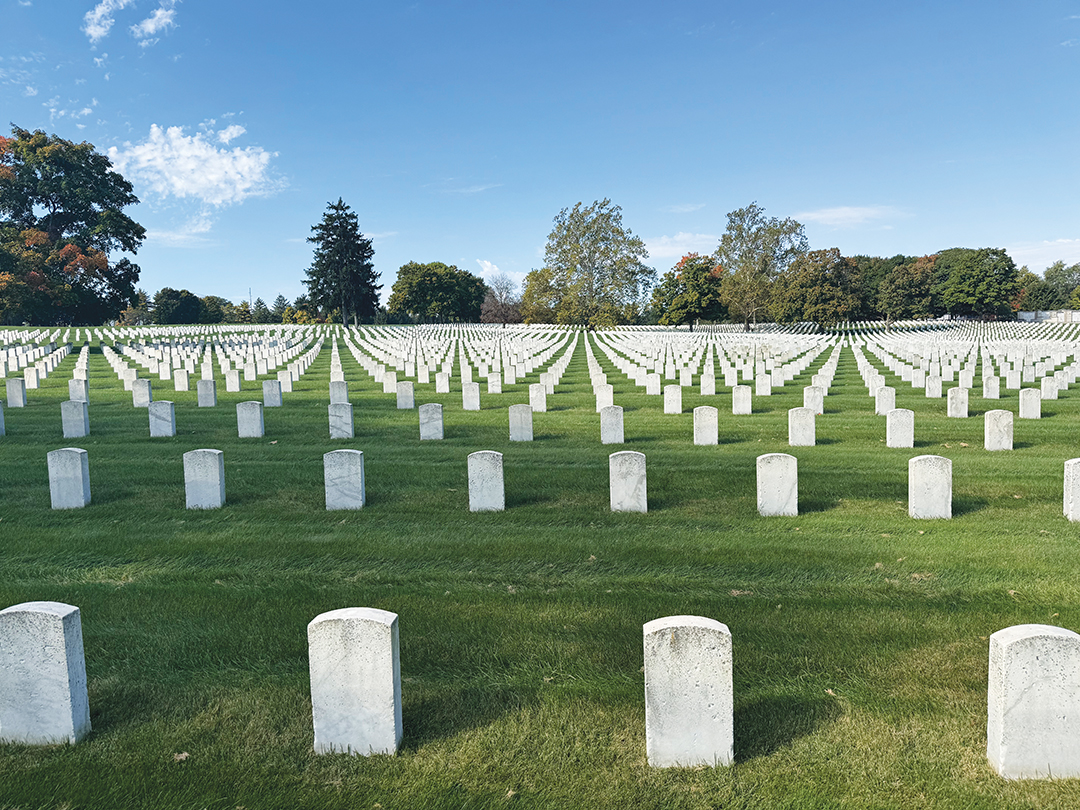
Beneath the 70-foot-tall Dayton Soldiers’ Monument topped by a statue of a “private soldier of the Volunteer Army of the Republic,” the graves of more than 11,000 Civil War Union soldiers cascade in perfect concentric half circles downhill and outward from Dayton National Cemetery’s highest point. Among them are seven, possibly eight graves of Jewish Civil War Union veterans.
Our knowledge of them comes from the records of the Shapell Roster of Jewish Service in the American Civil War. Since 2009, the professional researchers with the Shapell project have compiled this digital database (shapell.org) to identify every Jewish soldier and sailor who served in the Union and Confederate militaries during the Civil War. To date, the Shapell Roster offers profile pages of 7,000 Jewish Union Civil War veterans.
In the June Observer, we presented the stories of the three known Jewish Union Civil War veterans buried in our local Jewish cemeteries. Here, in time for Veterans Day, is what we know about those buried at Dayton National Cemetery.
Signed into being by Abraham Lincoln in March 1865, Dayton’s National Soldiers Home — now the Dayton VA Medical Center — was among the first three facilities to care for discharged Union army and navy veterans.
According to the U.S. Department of Veterans Affairs, the first Civil War veteran was buried there in 1867, the year it opened; the last one in 1947. In total, more than 62,000 veterans are now buried at Dayton National Cemetery.
The Jewish Union veterans buried there all convalesced at the Dayton National Soldiers Home and died there.
In the first part of this series, The Observer explored the confusion surrounding the final resting place of Simon Oberdorfer. A grave marker for him is placed at Temple Israel’s Riverview Cemetery as well as at Dayton National Cemetery. Though it’s likely his remains are at Riverview, it’s a mystery that has yet to be solved.
According to the American Battlefield Trust, the Civil War remains the bloodiest military conflict in U.S. history. An estimated 620,000 soldiers died on both sides. This surpasses World War II U.S. military deaths by about 215,000 souls. One in four soldiers who went to fight in the Civil War never returned home. For every three soldiers killed in battle, five more died of disease. And more than 400,000 soldiers were wounded.
Jewish immigration to the United States in the mid-1800s was mainly from central Europe in response to antisemitism and the economic and political upheaval in German states surrounding a spate of unsuccessful revolutions. Out of approximately 150,000 Jews living in the United States at the time of the Civil War, scholarly estimates put the number who fought for the Union at about 7,000 Jewish soldiers. Along with a sense of duty and a steady income, an incentive for immigrants to the United States to enlist with Union forces was a faster track toward naturalization.
Henry M. Auerbach
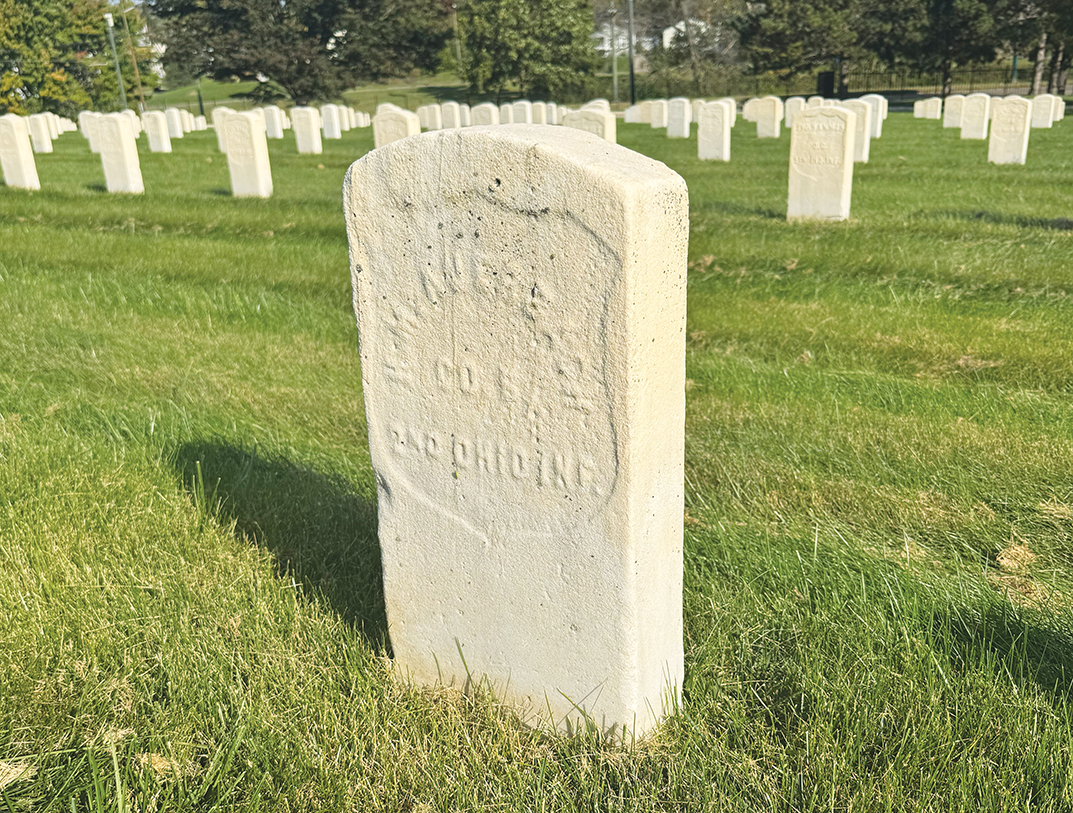
Born in Posen, Prussia in 1839, Henry M. Auerbach served three times in the Union Army. A farrier by trade, he first enlisted in April 1861 for three months as a private with Company B, 2nd Ohio Infantry and was mustered out that July. He reenlisted in May 1862 as a private with Company H, 85th Ohio Infantry and transferred in June 1862 to Company F, 86th Ohio Infantry as a private. He was detached as a commissary assistant in July 1862 and mustered out in September 1862.
In April 1864, he reenlisted at Columbus, Ohio, this time with Company G, 13th Ohio Cavalry as a farrier and was promoted to veterinary surgeon. He was honorably discharged in August 1865 at Petersburg, Va.
Three months into his service with the 13th Ohio, he wrote a letter to The Israelite Jewish newspaper, published by Rabbi Isaac Mayer Wise in Cincinnati. Then in its 10th year of publication, The Israelite had a national readership base of Jews who had emigrated from central Europe.
“All that we seek from you is to see whether those in the army could be furnished with a (prayer book) Zizis (prayer shawls) and Tefilin (phylacteries),” Auerbach wrote on behalf of the Jews of the Ohio 13th.
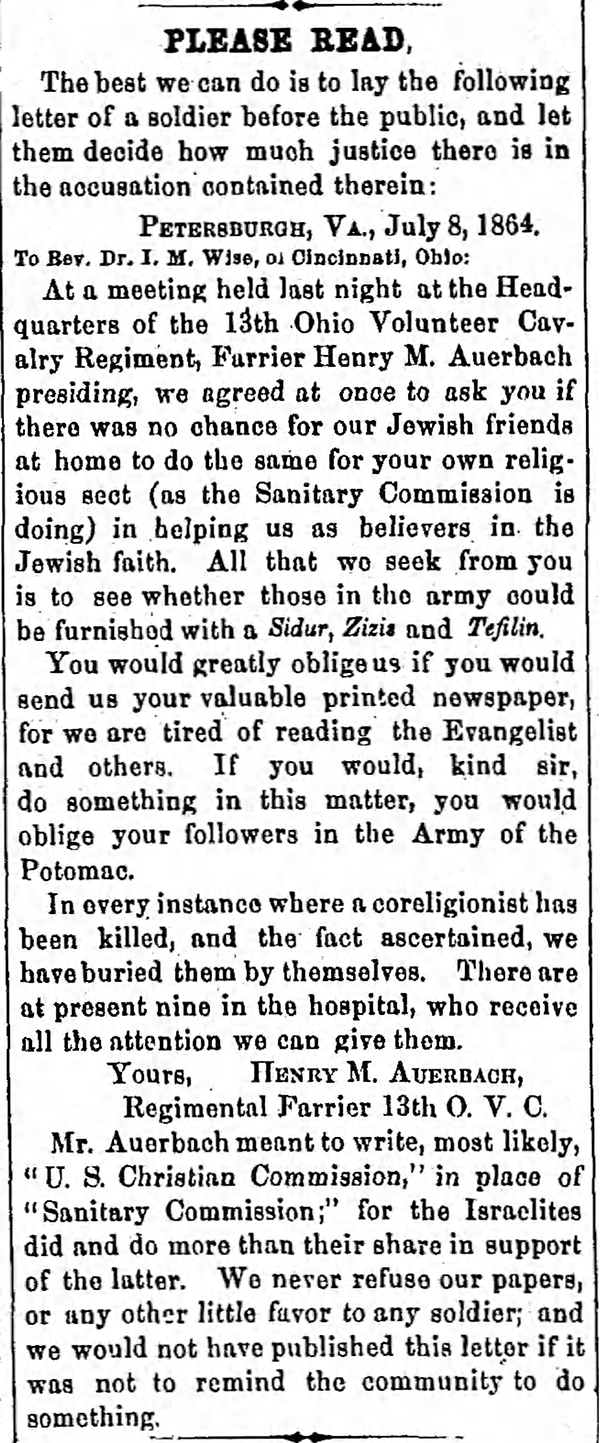
Auerbach also asked Wise to send copies of his newspaper, “for we are tired of reading the Evangelist and others.” He closed the letter informing readers, “In every instance where a coreligionist has been killed and the fact ascertained, we have buried them by themselves. There are at present nine in the hospital, who receive all the attention we can give them.”
Printed below the letter, Wise added, “We never refuse our papers, or any other little favor to any soldier; and we would not have published this letter if it was not to remind the community to do something.”
After the war, Auerbach served as a veterinary surgeon in Chillicothe, Ohio. He never married. He died of cancer in 1884 at 45-46 years old.
Herman Brod
An engraver by trade, Herman Brod of Gallizien, Austria enlisted as a private in Company A, 39th New York Infantry, in May 1861. He was wounded the following month at the Battle of Cross Keys in Virginia. That September, he was captured at the Battle of Harpers Ferry.
On the way to the battle of Gettysburg in 1863, he collapsed and was hospitalized for several months and honorably discharged for disability.
“I believe I broke down from exposure and (was) paralyzed by rheumatism,” Brod wrote in an 1879 petition for a disability pension. He added he was unable “to earn a living at my former or any other trade, for my fingers are powerless to handle any tools.”
To provide for himself and his family, Brod wrote that he had reenlisted for one year, 1865-66, with a veteran volunteer infantry where he did light duty, “until after getting worse again, they discharged me for not being able to do any service at all.”
In the same petition, Brod added: “Still, I solemnly declare that if I had to do it over again and I was able bodied as I was in 1861, I should enlist again and march under the Star-Spangled Banner until I would break down as I already did.”
Brod married twice, in Wyandotte, Kan. His first wife died in 1879. He married again in 1881 and divorced in 1887. He was the father of three daughters and one son with his first wife, three sons and one daughter with his second.
He died in 1920 at the Dayton Soldiers Home of mitral insufficiency at age 88. Brod had lived on the campus since 1892.
Arnold Gruber
While on picket duty (forward-guard surveillance) near Aquia Creek in Virginia in November 1862, Arnold Gruber was wounded by a bullet that ricocheted off a tree and struck him across both knees. His feet were already severely frostbitten from picket duty.
The private, who was born in Pozsega in the Austrian Empire, had enlisted with Company B, 119th New York Infantry in August 1862 in New York City when he was 18-19.
He was first treated for his knees at a field hospital and then sent to Lincoln Hospital in Washington, D.C. when he also contracted typhoid fever. He remained at the hospital for about eight months and was then sent to Knoxville, Tenn.
Gruber was promoted to the rank of corporal in July 1864 and honorably discharged in June 1865 at Bladensburg, Md. He died of gangrene and nephritis in 1916 at age 77-78.
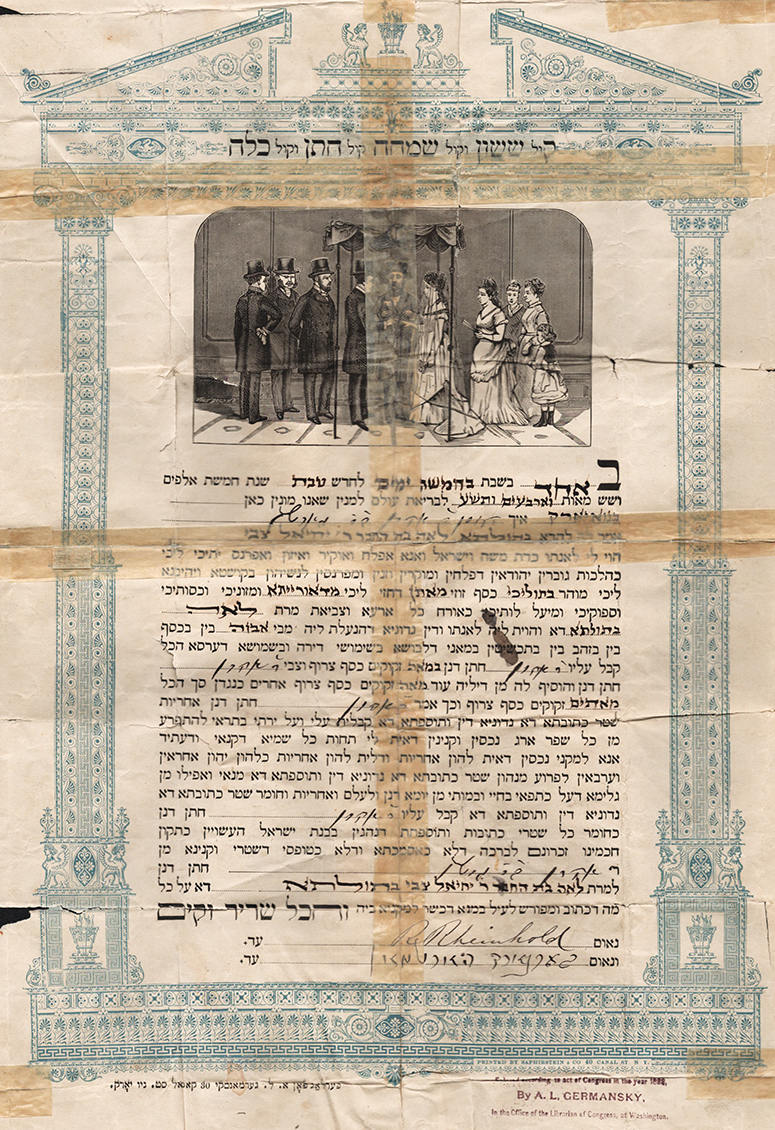
His profile page at the Shapell Roster includes a scan of the ketubah (Jewish marriage contract) from his wedding to Lena Davidson in Manhattan in 1888. After his death, she submitted the ketubah and an English translation with her Declaration for Widow’s Pension form.
Nathan Lyons (Loeb)
Born in Claiborne, Ala., Nathan Loeb enlisted as a drummer boy with Company A, 15th U.S. Infantry at age 15 in 1863 at Fort Adams, Newport, R.I. He was raised by his aunt and uncle, Theresa and Leopold Loeb; his mother died when he was three weeks old.
On Jan. 11, 1865, Loeb deserted the infantry at Lookout Mountain, Chattanooga, Tenn., only to reenlist under the name Nathan Lyons with Company I, 188th Ohio Infantry at Cincinnati 12 days later. He was honorably discharged that September at Nashville, Tenn.
He and his wife would make their home in Bethel, Clermont County, Ohio.
In an 1896 deposition to receive a pension, he claimed that abuse led him to desert at Lookout Mountain:
“I enlisted in this organization as a drummer boy but was pushed in as a private and had to carry a gun all the time…The fact is I worked along and beat my way…on the train with the soldiers from Nashville, Tenn. to Cincinnati Ohio…I left the service on account of rough treatment. I was nothing but a boy and every time I had a dirty gun or something, they would lock me up in the guard house. I just walked away and they never seemed to bother about me again…I complained in this service with pains across the small of my back and drowsiness but I was not in hospital or excused from duty on account of sickness that I now remember.”
Nathan Lyons died in 1912 of myocardial insufficiency at age 64.
Henry C. Phillips
Little information is available to date about Henry C. Phillips, born in 1845 in Kentucky and who enlisted in Company K, 29th Pennsylvania Infantry as a drummer in July 1861. He was honorably discharged in July 1865.
The Shapell Roster does note that his brother, Isaac N. Phillips, also served in the company and that their sister, Rosa, was married to Jewish Confederate soldier Benjamin Hilborn of Mississippi in 1873. Henry C. Phillips died in 1906 at age 60-61.
Henry Straus
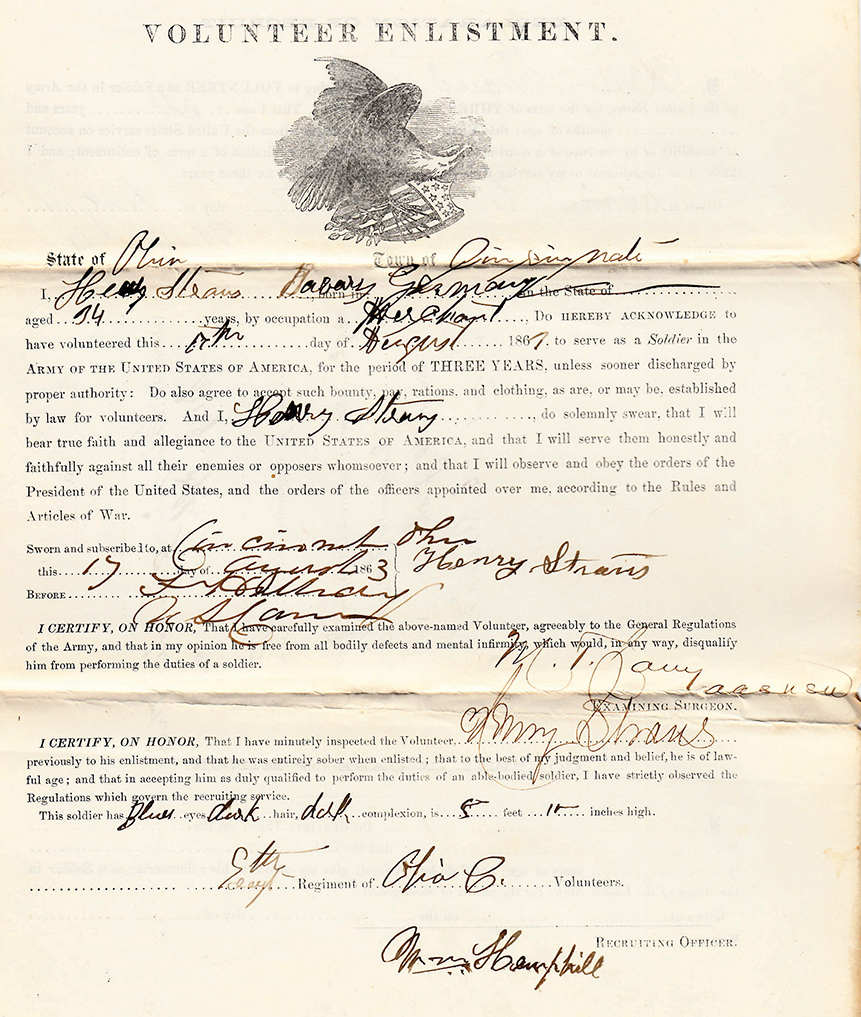
Bavarian Jew Henry Straus, a salesman in his early 30s, enlisted as a private with Company A, 2nd Iowa Infantry, in May 1861. In July 1863, he was honorably discharged due to disability at Memphis, Tenn.
His discharge certificate indicated three reasons: “Said soldier is rendered unfit for the service caused by the easy and frequent dislocation of left shoulder joint and demoralization and too meek nerved to face the enemy in battle…Chronic alcoholism. He is basically intoxicated at every opportunity. Has frequent attacks of delirium tremens…and he is of no use to the service in any capacity whatsoever and never will be.”
Even so, Straus reenlisted a month later as a private with Company K, 9th Ohio Cavalry in Cincinnati. In November 1863, he was promoted to commissary sergeant.
According to his declaration for an invalid pension in 1884 in Cincinnati, while in service in North Carolina in July 1865, “he was thrown from his horse, which became frightened in a charge upon the enemy, dislocating his left shoulder, greatly disabling him at the time.”
Records indicate he was honorably discharged and mustered out on July 20, 1865. Eight years after his petition, in 1892, the government granted him his invalid pension.
He died of a cerebral hemorrhage in 1896 at age 68-69. Henry Straus’ gravestone was set with his last name spelled incorrectly, as Strauss.
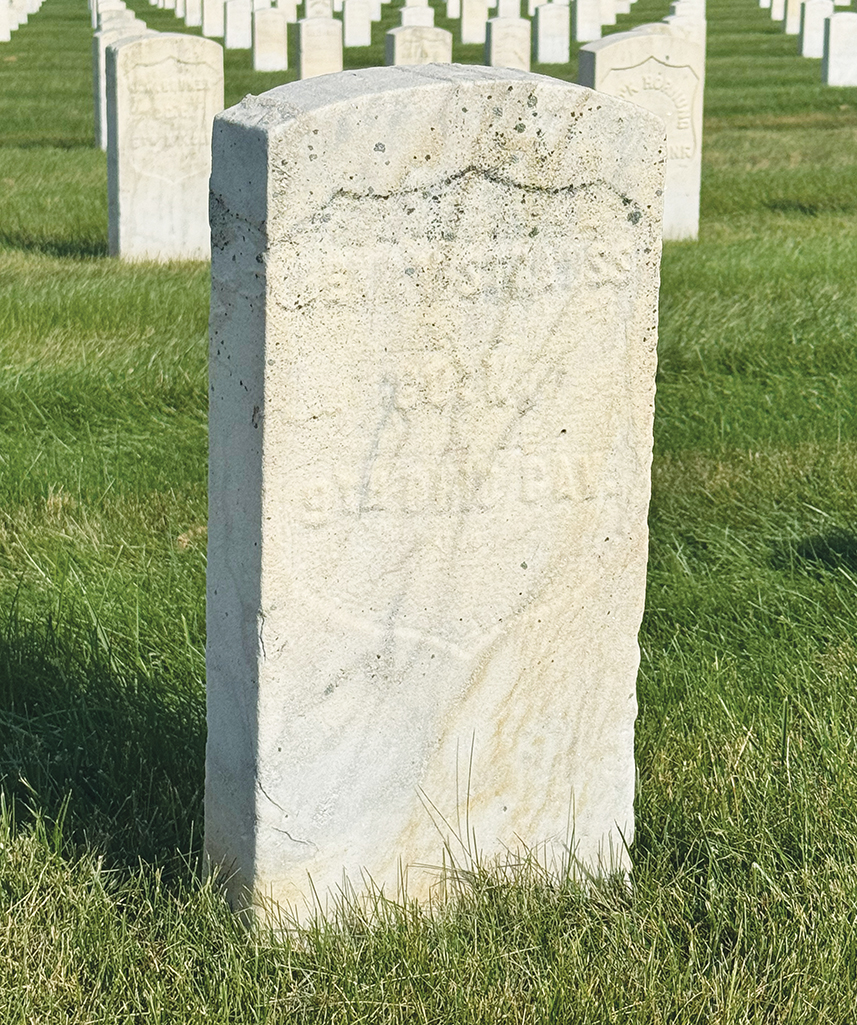
David Strauss
Another Bavarian, David Strauss, enlisted with Company B, 63rd Ohio Infantry in October 1861 at Chillicothe. As with other Jews buried at Dayton National Cemetery, disability didn’t keep him from reenlisting — in his case, two more times.
His first honorable discharge for disability came in July 1862 at Columbus due to pulmonary tuberculosis, a severe and contagious bacterial infection of the lungs: “He is not fit for duty and never will be. He has not done duty for eight months.”
Shapell indicates that a year later, in August 1863, he reenlisted for a period of six months with Company D, 4th Independent Battalion Ohio Cavalry at Camp Dennison, Symmes Township, Hamilton County, and was assigned to an escort guard in Knoxville, Tenn. in October 1863. Strauss was honorably discharged in March 1864 at Cincinnati.
His third and final enlistment was as a private for 100 days in May 1864 with Company A, 149th Ohio Infantry (National Guard) at Chillicothe, from which he was honorably discharged in August 1864 at Cincinnati.
Strauss died of acute enteritis in August 1907 at age 63-64.
Marshall Weiss is founding editor and publisher of The Dayton Jewish Observer and project director of Miami Valley Jewish Genealogy & History, a program of the Jewish Federation of Greater Dayton.
Related: Three known Civil War veterans are buried in our Jewish cemeteries.
Related: Jews & the Civil War integral to Piqua’s history.
To read the complete November 2026 Dayton Jewish Observer, click here.