

A living blueprint

America 250 — Part Four
In the news series
Jewish Family Education with Candace R. Kwiatek, The Dayton Jewish Observer
The Relative Influence of European Thinkers and the Bible on American Political Thought. How the Bible influenced the Founding Fathers. Proclaim Liberty: How the Hebrew Bible Molded America. The Hebrew Bible in American History and Today’s Headlines.
In 1450, German inventor Johannes Gutenberg introduced the mechanical movable-type printing press to Europe. Over the next five decades, European presses exploded with activity, churning out an estimated 10 to 20 million individual books across 40,000 distinct titles.
Alongside classical Greek literature, humanist philosophy, and scientific treatises, religious texts dominated the market.
Jewish entrepreneurs quickly seized on the new technology. By 1500, they had printed over 200 Hebrew titles, 10 including Hebrew Bibles, Hebrew dictionaries and grammar books, Talmudic tractates, Maimonides’ Mishnah Torah, and Rashi’s Commentary on the Torah — the first dated, stand-alone Hebrew book ever printed.
For the first time, scholars, nobility, and wealthy professionals could buy and study identical, clear copies of ancient Christian, Jewish, classical, and secular texts that had long been locked away in rare, handwritten manuscripts. This accessibility fundamentally transformed Europe’s intellectual landscape.
Driven by Renaissance humanism’s emphasis on returning to original historical texts, Christian scholars began studying the Hebrew Bible, rabbinic literature, and classical Jewish commentaries.
This movement, known as Christian Hebraism, aimed to bypass centuries of translation and copying errors to uncover the literal, historical meaning of the text.
In doing so, these thinkers unlocked something unexpected: a revolutionary model of the “secular” civic and political principles of government in what they viewed as an ancient Hebrew republic: separation of powers (leader, courts, priesthood), decentralized leadership (independent tribes), the rule of law (Torah), and the consent of the governed (acceptance at Sinai).
This intellectual revolution didn’t stay confined to Europe; it sailed across the Atlantic with the first American settlers who brought with them a deep immersion in Christian Hebraism and their newly printed English Bibles that resulted from it.
They did not view the Hebrew Bible as a relic of ancient history, but as a living blueprint for society, becoming most prominent in the Puritan concept of America as the “New Israel.”
America’s colonists used scriptures to construct their legal codes, structure their towns, and establish a foundational culture of literacy and self-governance, more aptly termed political Hebraism.
Long before the American Revolution, the political soil of the New World was already deeply fertilized by the ideas of the ancient Hebrew text.
Modern writings usually credit the European Enlightenment for America’s founding documents. However, this narrative skips a crucial step: the Enlightenment itself grew directly out of Europe’s deeply biblical soil.
Long before Locke, Montesquieu, and Voltaire were celebrated as architects of secular modern politics, their ideas were cultivated in centuries of biblical, Jewish, and Christian religious thought.
Ultimately, if the Enlightenment was the architect of the American experiment, the Hebrew Bible was its indispensable blueprint.
The biblical roots of the Enlightenment. The political philosophy behind America’s founding was deeply shaped by European thinkers who drew directly from biblical text.
Foundational theorists like John Locke integrated scripture and extensive theological commentaries to justify core concepts like natural rights.
Rather than discarding religious texts, these political philosophers looked to their conception of an ancient Hebrew republic as the model on which to build a constitutional republic, using it to champion a society governed by the rule of law instead of the whims of a monarch.
The Covenant and the Constitution. America’s reliance on written, binding documents to limit government power began long before the U.S. Constitution, rooted in the biblical concept of a covenant brought by early settlers. This sacred agreement between God, rulers, and the people served as the direct predecessor to social contract theory.
By signing the Mayflower Compact in 1620, the Pilgrims explicitly used this framework to establish a tradition of self-governance under a supreme law nearly 170 years before the Constitution was ratified.
Human dignity and the law. The Declaration of Independence’s proclamation that “all men are created equal” with inherent dignity and rights is a direct political application of the Bible’s concept of b’tzelem Elokim, that human beings are made in the image of God. Unlike ancient Roman and Greek democracies that restricted rights to citizens, wealthy males, or the ruling class, this radical American idea is a unique inheritance of the Hebrew Bible.
Unlike ancient Roman and Greek democracies that restricted rights to citizens, wealthy males, or the ruling class, this radical American idea is a unique inheritance of Judeo-Christian theology.
Checks, balances, and human nature. The American government’s structure is deliberately trifurcated to maintain a system of checks and balances.
While inspired by the Enlightenment thinker Montesquieu, the Founders’ primary motivation for this separation of powers stemmed from a biblical view of the fallibility of human nature.
They maintained a deep skepticism of human authority, recognizing inherently flawed people are prone to corruption when given absolute power.
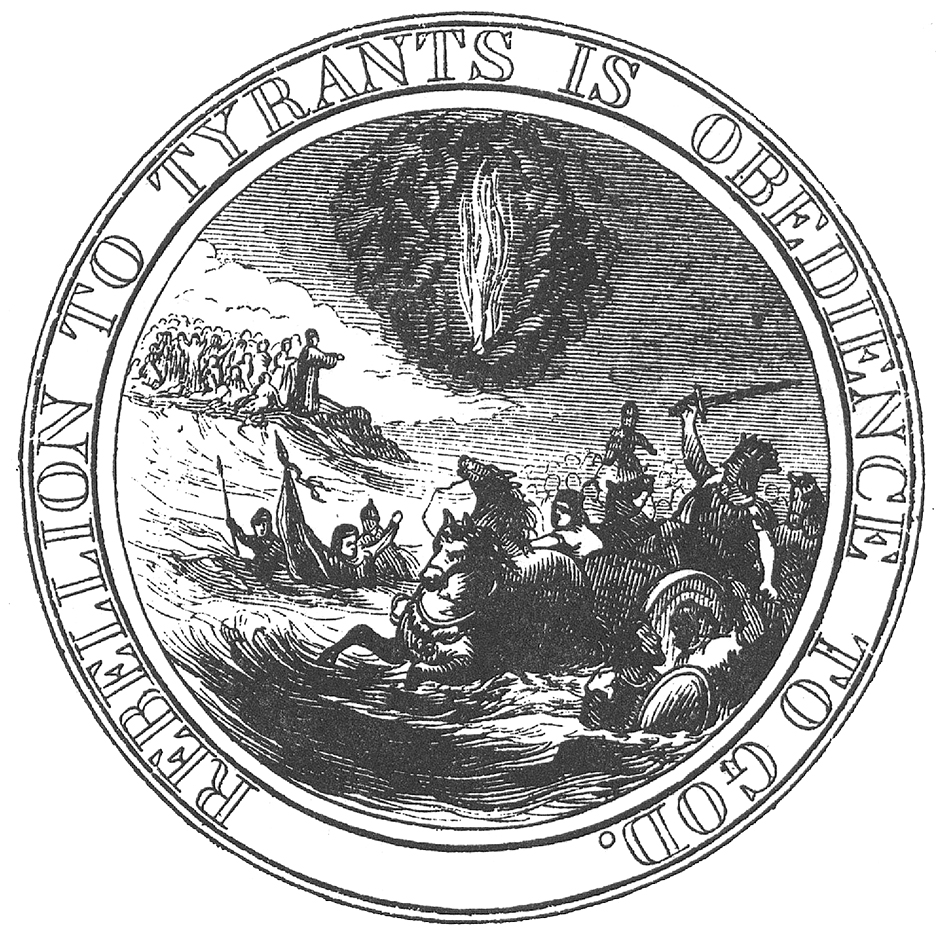
The vocabulary of the Revolution. The colonists widely viewed their rebellion against King George III as a modern-day Exodus. In this cultural narrative, America was the New Israel, the Atlantic was the Reed Sea, and King George was Pharaoh. This biblical imagery was so influential that when Benjamin Franklin designed the first proposal for the Great Seal of the United States, its reverse depicted the sea closing in on the Egyptians surrounded by the motto “Rebellion to Tyrants is Obedience to God.”
Ultimately, it was the printing-press revival of early Jewish texts that gave America’s Founders the philosophical framework for the new nation, political scientist Eric Nelson explains.
By placing the blueprints of the Hebrew Bible —including ideas of covenantal law, checks on power, and resistance to tyranny — directly into the colonial mainstream, the printing press did more than mass-produce books. It transmitted the ancient Jewish ideas that would, centuries later, directly inform the drafting of the Declaration of Independence and the Constitution.
The words of news blogger Elroie Agam best capture the real story of America 250: “A nation is not built only by those who write its philosophy. It is built by those who finance it, fight for it, pray for it, organize for it, and give it a moral language.”
Ultimately, our nation is built — or not — by each of us every day.
Literature to share
The Last Free Women: A Daring Escape from Afghanistan and Coming of Age in America by Rebecca Blumenstein and Diana Kapp. As the Taliban seized Kabul in 2021, The New York Times carried out a frantic, high-stakes operation to rescue Afghan colleagues and their families. Among them were four young women whose journeys of flight from Afghanistan and reinvention in America form the heart of this riveting memoir. It’s an essential reminder of the human lives behind the headlines — and the enduring power of hope.
Three Pieces of Broken Glass: A Picture Book by Emily Barth Isler. “What if I told you…that it’s not only good luck to break glass sometimes, but it’s also tradition?”asks GreatGrandmother Inge. Pointing to three glass shards on her windowsill, she gently tells their stories: a wedding, a Kristallnacht warning, a family’s unexpected reunification. Ideal for elementary ages and reading aloud, the tales emphasize the importance of keeping and sharing memories along with seeing the world in a hopeful light. An author’s note includes images and the family history that inspired this story.
To read the complete October 2026 Dayton Jewish Observer, click here.