
Oakwood High School senior: ‘Israel’s so close to my heart’
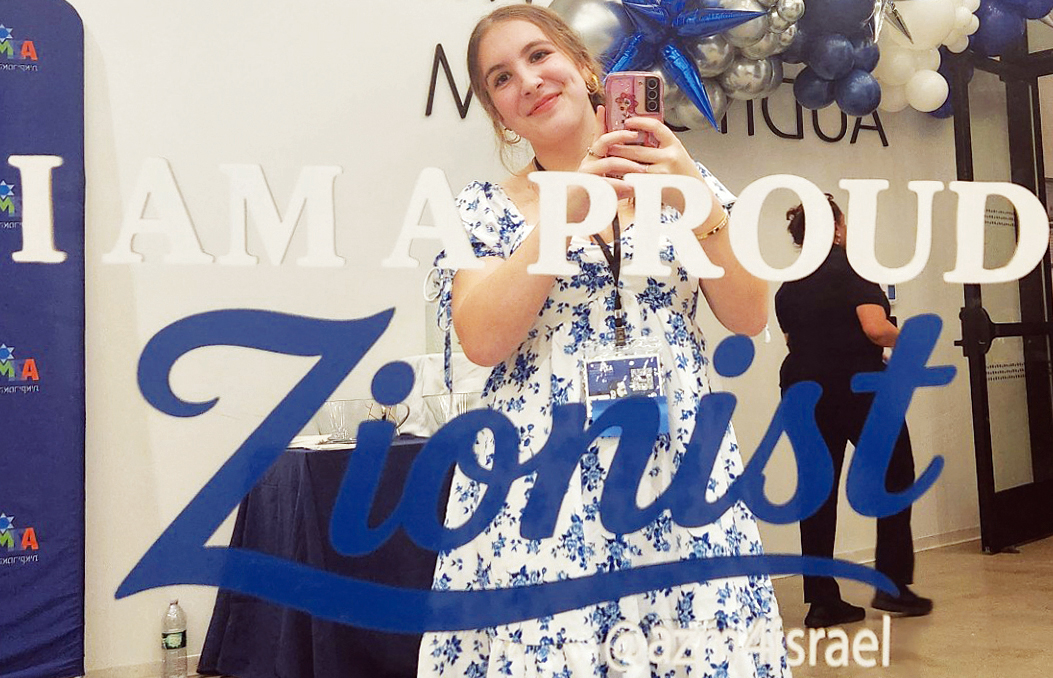
Anti-Israel vandalism at her school led Ruth Glaser to start a Jewish Student Union there. She’s now a national Zionist youth activist.
Interview by Marshall Weiss, The Dayton Jewish Observer
Ruth Glaser, 17, has a message for Dayton’s Jewish community. “There are people in the younger generation of Jews who are pro-Israel and who are Zionists, and it’s their identity, and they love it,” she told The Observer after returning from the American Zionist Movement Biennial Assembly in New York, Dec. 7-8; she attended as one of 27 youth participants.
As the national board of Young Judea’s representative to the conference —and that board’s social action programmer — she met Israeli President Isaac Herzog. She’s also a high school intern with Stand With Us, an international Zionist leadership training organization, and is about to begin her Eagle Scout project.
Here, Ruth talks about how she became a Zionist activist, why she started Oakwood High School’s Jewish Student Union, and what she’s learning in those roles. This interview has been edited for length and clarity.
When did you first get involved with Zionist activities?
With Young Judea. I’ve been going there since I was in third grade, summer camp. They have a teaching program also. I went to a convention my sophomore year, and they didn’t have a lot of people running for the Midwest region youth board that creates the programming. One of my friends was like, “Do you want to run?” I thought why not? I’ll give it a try. I fell in love with doing Jewish leadership and found more opportunities, as many as I could.
What does your internship for Stand With Us involve?
It’s around 200 teens out of 1,200 who applied. Every month, I meet with my local adviser, and I meet with my whole group, the whole Midwest region. We plan programming and talk about if I’ve experienced antisemitism or any anti-Israel stuff. I’ll talk with her about it, what should I have done, what will I do?
On the group meeting, it’s educational presentations. Sometimes it’s about Israel’s heritage. Last time, it was about Mizrahi Jews (from the Middle East, North Africa, Central Asia), which was interesting. A lot of it is leadership training. We hear from amazing speakers who have crazy and amazing stories to share.
What are you up to at your school?
I started a Jewish Student Union this academic year. This also goes into why I started getting involved with Zionist programs. A few years ago, there was a girl who vandalized the Israeli flags in my history teacher’s classroom. He has a bulletin board border with all the world flags on there. And there happened to be Israeli flags. She took a marker and crossed them all out.
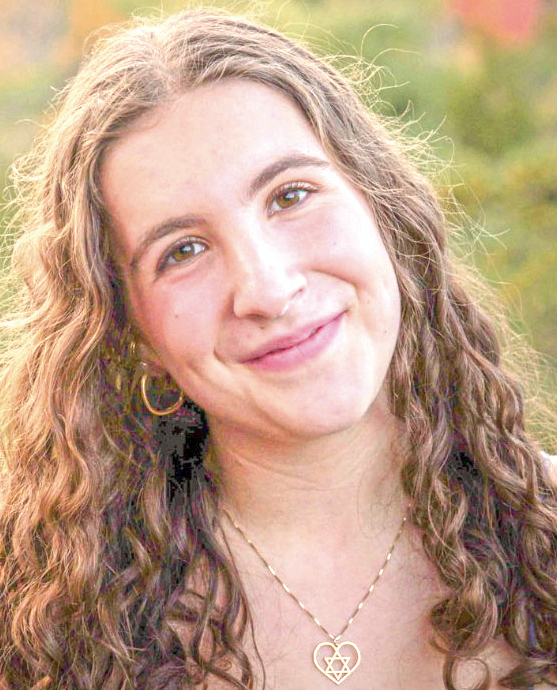
He said, “I don’t know who did this, but if it’s anyone in here, you are entitled to your opinions, but you can’t take them out like this.” This was a girl I’ve been going to school with since about third grade. I wasn’t on social media at the time. I really didn’t know how bad antisemitism was getting. This was my first time experiencing it. People aren’t so forward about their opinions to me because I’m very outwardly Jewish. I wear a Star of David every day.
The girl who vandalized the Israeli flags happens to be in my friend group by affiliation. She’s dating someone in the friend group. I never want her to come with me. And then the whole group’s like, but we can’t kick her out because then we have to kick him out. My friend who knew that it was her and told the teacher told me, “I’m still friends with her because she’s not antisemitic, she’s anti-Zionist.”
The next day, we’re riding in the elevator, and I said, “Hey, yesterday you mentioned that anti-Zionism isn’t antisemitism. And I don’t think that’s right.” And she was like,” I don’t want to talk about it. We’re going to disagree forever on this, so I don’t want to talk about it.”
I was like, “But I think we should. If you’re going to ride in the elevator every day with me, you’re my friend. I think we need to. Israel is fighting this war right now, and unfortunately, casualties happen in war. I’m not saying I wish they happen on either end. If you think that Israel doesn’t have a right to exist because they’re in this war, that’s antisemitic.”
She started yelling at me about how we were never going to agree. A lot of the conversations I have result in yelling. And then I’m able to just remind myself that maybe I was right. I’m not going to be able to change their mind. It’s definitely the hardest part of it all.
This was sophomore year. Junior year, I got involved in programs like Stand With Us and Young Judea. And then I started thinking, well, there are other Jews at Oakwood who probably have seen something or heard something in the hallways, and they may feel really alone and might need someone, a group to go to. I ended up figuring out that the JSU was an option and got really excited.
I did outreach to all the Jewish students. I sent emails, texts. We have a meeting every month. I know they feel it’s really nice to have a place like that to go to, a safe place. And it’s not nearly as much talking about antisemitic incidents. That’s always been “Contact me if something happened.” It’s a lot of celebrating holidays and decorating. It’s been really special to have that place at Oakwood.
How many Jewish students are at Oakwood High School?
I would say 20 to 30. Normally get around seven to 10 each week for JSU.
What’s the environment like there for Jewish students?
When I was in elementary school, being the Jewish kid was so fun. It was special. I got to miss school for the (Jewish) holidays. And I didn’t believe in Santa, that was the biggest thing. I remember when the Pittsburgh shooting happened, I was in fifth grade. I had a few friends of mine who acknowledged it and were like, this is really terrible, how could this happen? It was such a big deal.
Oct. 7 happened, and less people approached me. Teachers asked, how’s your family? Are you OK? Because I’d just been in Israel that summer.
Then the Israeli flag incident with this girl happened, and I was like, Oakwood has this climate. It’s a handful of students who go by unnoticed. That can be very frustrating. The occasional Nazi swastika gets drawn on the desk or someone jokes about it in the hallway. That immaturity. Those things for me, for a while went under wraps. Now I’ve gotten to a place where no, it’s not OK to say that or joke about it.
It’s not nearly as bad as other places I know in Ohio that do have much, much bigger problems with it. Students feel comfortable approaching the administration or teacher about it when they see it, whether they’re Jewish or otherwise. I think Oakwood, because of how tiny and tight-knit we are, people mostly feel they have a safe adult to turn to.
Does the administration respond when these things happen?
Yes.
Are there anti-Israel activist students at the high school?
In the Jewish community, no one I have talked to or met is anti-Zionist. They have their right to criticize Israel, but it’s never gone to “Israel shouldn’t exist.” Outside of the Jewish group, yes. Unfortunately, a lot of people I was friends with or worked with did come out and start saying all this stuff.
The girl I mentioned earlier, she’s very strong in her anti-Zionism beliefs. A lot are on the premise that Israel is committing a genocide, and the U.S. shouldn’t fund it. I think a lot of it comes from a misunderstanding of the conflict and what’s happening. I think a lot of it is one-sided political and seeing so much of the news.
How do you handle that?
It is really hard. It gets the blood boiling a little bit. You have to back down but also have a conversation. I text my Stand with Us adviser.
With the girl I mentioned, I went into “You’re throwing around the word genocide a lot.” Oakwood offers a Holocaust and genocide class. And the teacher I’ve taken it with does an amazing job explaining all the points and goes into the Holocaust, goes into other genocides, talks about what genocide actually means, debunks all these things. And I knew she was taking it at the time. I texted her, “I think you’re too smart to be throwing around this word because it has a meaning.” And she was like, “I’m not going to be able to see it as anything else than what it is.”
I feel like I lost this conversation because I didn’t get to prove my point. But Stand with Us says that 90% of people will have an open mind. 5% are completely closed off. They’re not changing their opinion. The other 5% are on your side. And I think she falls into the closed off 5%. I’ve tried so hard.
But I also had a conversation with my friend who looked me in the eyes and said, “Israel’s committing a genocide” the other day. And I did debunk the theory because I went, “You know what the word genocide means? You took this class with me. Here’s what’s actually happening in Israel.” And she went, “Oh, so it’s Hamas.” Sometimes you have really successful conversations and sometimes you don’t. But I think it’s important to just have the conversation.
Stand With Us pushes a lot of the idea that you have to stay calm and collected. That’s hard. But it is really important in an argument. When people talk about Israel committing this genocide, a lot of it is about Palestinian children. All these children are stuck, are starving and suffering, there’s so much suffering.
You have to say, “Yes, and suffering is horrible.” So many people forget that this is a war and there are casualties and it is unfortunate on both sides. You don’t disregard that. There is empathy and there is sympathy towards this other side. There are problems and there are tragedies happening, and you don’t get to turn it into hate towards the Jewish people.
You could just keep your beliefs to yourself. Why have you taken this on?
It’s a difficult question to answer. At one point I thought, as Jews, our job is to be Jewish. Our job is not to fight antisemitism. That’s society’s job. That’s what they’re supposed to be doing. And on the other hand, I look at it and I think I’ve been given such a privilege to be part of all these communities and all these groups that I’ve been able to be a leader in.
I feel the need to speak out because you have to start somewhere. Eventually I hope I don’t have to keep doing this and standing up for all these things. But Israel’s so close to my heart and my religion is so close to my heart. As lonely and as anguishing as that feels, there have been a lot of learnable moments, and there has been a lot of good that’s come out of it. And even when it is hard, I have so many people who have my back, I’m fortunate. And so it makes it a little easier.
What will you do after high school?
I want to go into music. I sing, I’m in music theory right now. I want to be able to write my own music and produce. Law is my backup. But I am taking a gap year in Israel next year. I’m going with Young Judea’s year course.
To read the complete February 2026 Dayton Jewish Observer, click here.