

Greater than ourselves
In the News Series
Jewish Family Education with Candace R. Kwiatek, The Dayton Jewish Observer
Recent headlines tell a sobering story: Human freedoms ‘fallen off the cliff,’ new study reveals. Free speech is facing threats in the US and beyond. ‘The Last Generation of Freedom’? The Quiet Growth of Global Surveillance Culture. Liberty at risk as threats to freedom grow. Land of the Free? Fewer Americans Agree.
Painting a broad picture of world trends, these headlines also underscore specific challenges facing America, with origin and aspirations rooted in being “the land of the free.”
While the articles themselves analyze specific metrics — civil liberties, economic regulations, safety, the rule of law — the most compelling takeaway is a personal one expressed by one of the related survey questions: “How satisfied are you with your freedom to choose what to do with your life?”
This echoes the Greek Stoic Epictetus, who famously asked, “Is freedom anything else than the right to live as we wish?” For him, the answer was a blunt, “Nothing else.”
However, he wasn’t advocating for hedonism. Epictetus taught that living as we wish, in true freedom, requires disciplining one’s thoughts and reactions — prioritizing virtue over impulse. His philosophy is best captured by the maxim: “No man is free who is not master of himself.”
The tension between internal discipline and external rights continues in modern discourse.
In a recent forum discussion regarding what freedom means to Americans, one respondent perceptively noted, “The American concept of freedom is rooted in individualism…your (unlimited) right to be you…As a European…I like that there are some social expectations to keep me in order, but I also enjoy being able to express myself.”
These views all prioritize freedom in relation to the individual — whether through internal autonomy, moral self-reliance, or community boundaries.
Judaism, however, offers a multi-faceted alternative that harmonizes individual and communal identity, viewing them as interdependent forces rooted in the foundational narrative of the biblical Exodus.
From the burning bush onward, God’s message to Moses was clear: the Israelites were to be freed from Egyptian bondage not merely for the sake of liberty, but in order to serve God.
This mandate was reinforced throughout the plagues, as Moses was repeatedly instructed to tell Pharaoh, “Let My people go that they may serve Me.”
Barely settled at the foot of Mount Sinai after their miraculous liberation, the Israelites were reminded of the purpose of their freedom.
God declared, “You have seen what I did to the Egyptians, how I bore you on eagles’ wings and brought you to Me. If you will obey Me and keep My covenant, you shall be My treasured possession…a kingdom of priests and a holy nation.”
Speaking as one, the people affirmed this covenant, declaring, “All that the Lord has spoken we will do!”
At first glance, it seems the Israelites had simply traded one master for another.
But the Exodus from Egyptian slavery was never intended to be an end in itself.
In the terms of philosopher Isaiah Berlin, it was a transition from “negative liberty” — freedom from external restraint — to “positive liberty,” the freedom to serve a higher purpose.
Nature abhors a vacuum. Something had to replace the Israelites’ former taskmasters, the tasks, and even the social structure and culture built up over centuries of slavery.
Had Israel not committed to serving God at Sinai, the void created by the absence of authority, structure, and purpose likely would have been filled by immediate re-enslavement by surrounding nations, internal anarchy, or a turn to pagan servitude.
Exodus itself makes this very point in the story of the Golden Calf. This was more than a rebellious sin. Unable to handle the “vacuum” of an invisible God, an absent leader, and a lack of direction or purpose, the Israelites fashioned a visible substitute in a tangible, familiar form.
Seeing that the Israelites had “broken their engagement” with the Divine, Moses shattered the original tablets at the foot of the mountain, a transformative act that redefined the relationship between God and the Jewish people.
The first set, crafted entirely by God, had been presented as a gift to a passive audience, one who had played no role in their creation and put forth no effort to receive them.
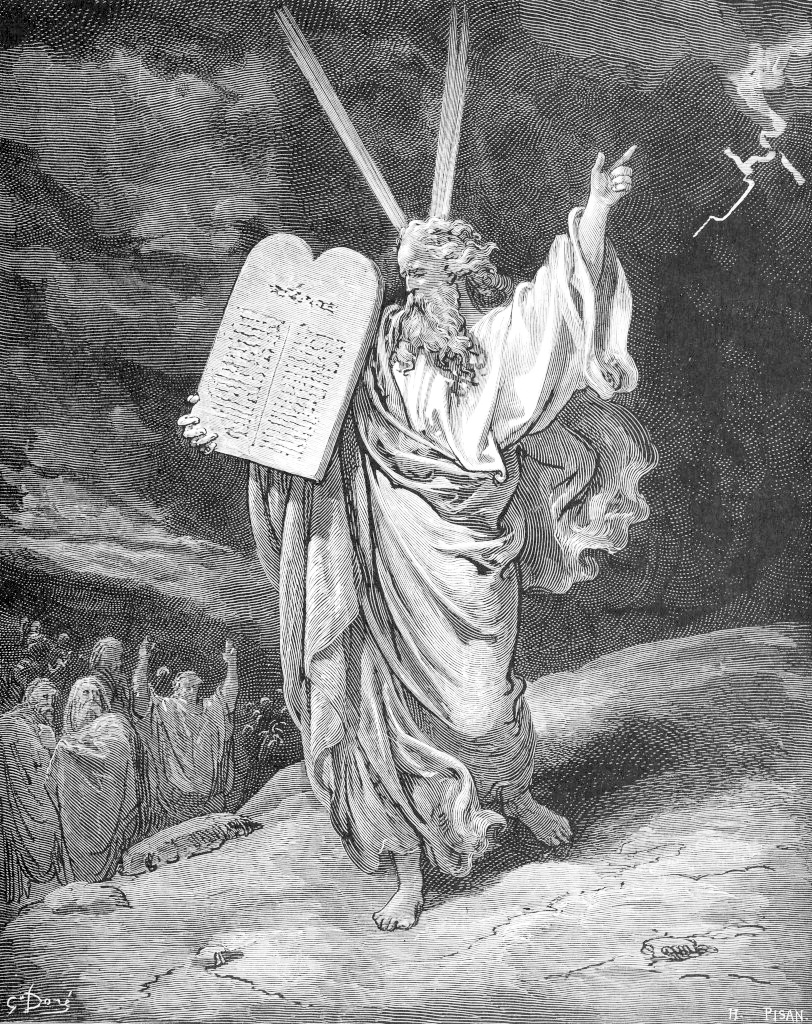
It was a supernatural moment that briefly inspired the Israelites but failed to transform their character. This failure set the stage for a more active partnership.
The second set of tablets, hewn by Moses but inscribed by God, signaled the moment the Israelites became partners in Creation.
No longer passive recipients, they were now called to invest human effort to repair the world’s brokenness and to serve as a beacon of moral clarity and holiness.
Because a human hand helped shape the stone, a new paradigm emerged: a living Torah, Torat Chaim, a dynamic, ongoing guide that required continuous study, interpretation, and Divine-human partnership.
This Torah ceased to be merely an external gift and became a catalyst for permanent change in the individual and in the world. It offered a new freedom: freedom for the sake of making a difference.
Today’s headlines suggest that many people are less than satisfied with their freedom.
Perhaps this dissatisfaction reflects a life lived only with “freedom from” (restraint) or “freedom to” (impulse) but missing the “freedom for” described at Sinai.
In the words of theologian and writer Neal Hardin, “True freedom is not primarily a freedom ‘from’ external restraints, nor the freedom ‘to’ enact our own will, but a freedom ‘for’ something greater than ourselves.
Literature to share
Fear No Pharaoh: American Jews, the Civil War, and the Fight to End Slavery by Richard Kreitner. A 2025 National Jewish Book Award Finalist, Fear No Pharaoh offers a gripping look at the diverse and often conflicting roles Jews played during the American Civil War. Written in a fast-paced, narrative style, the book profiles six figures ranging from abolitionists to Confederate leaders to show how the community grappled with the moral crisis of slavery. These vivid portraits reveal a community struggling to reconcile religious tradition with the era’s brutal political realities.
The Prisoner and the Writer by Heather Camlot, illustrated by Sophie Casson. This visually striking account brings the dramatic story of the Dreyfus affair to life for upper elementary readers. Using a clever parallel layout, it contrasts Alfred Dreyfus’ lonely exile with Émile Zola’s brave fight to prove his innocence. It’s a fast-paced way for kids to learn about a major moment in Jewish history. Included at the end is an author’s note and additional historical context to help explain why standing up against antisemitism still matters today.
To read the complete April 2026 Dayton Jewish Observer, click here.