
Demographer’s deeper dive into Miami Valley region finds more Jews
Ira Sheskin’s new estimate of about 7,000, up from 4,000 in 2023, reflects more extensive research rather than Jewish population growth.
By Marshall Weiss, The Dayton Jewish Observer
There are more of us here than we thought. Significant funding for a national study on the number of Jews in all 435 U.S. congressional districts has allowed demographer Ira Sheskin to dig deeper into local Jewish communities that have not conducted population studies in recent years.
His 2025 estimate for the Miami Valley is about 7,000 Jews, up from 4,000 in 2023. The Jewish Federation of Greater Dayton’s database identifies 2,493 Jews across the Miami Valley, 35% of Sheskin’s estimate for the area.
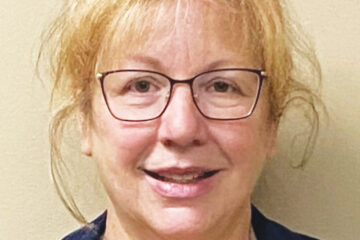
Sheskin is director of the Jewish Demography Project of the Miller Center for Contemporary Judaic Studies at the University of Miami. Since 2006, he has served as editor of The American Jewish Yearbook.
He’s also helped The Observer analyze the Federation’s list of identified Jewish households across the Miami Valley since 2015.
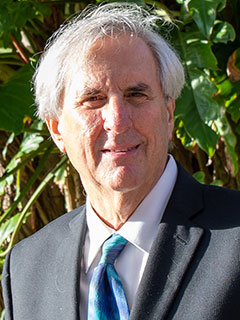
“That’s a conservative estimate. It’s much more typical for Federations to have well under half on their lists these days,” he said of his latest study.
“I think it’s a lot closer to the truth than what we’ve had in the past,” he said of data from the eight-month project for the Jewish Electorate Institute, a nonprofit that “surveys, interprets, reports, and educates the public about the perspectives, voting behaviors, and motivations of the American Jewish electorate.”
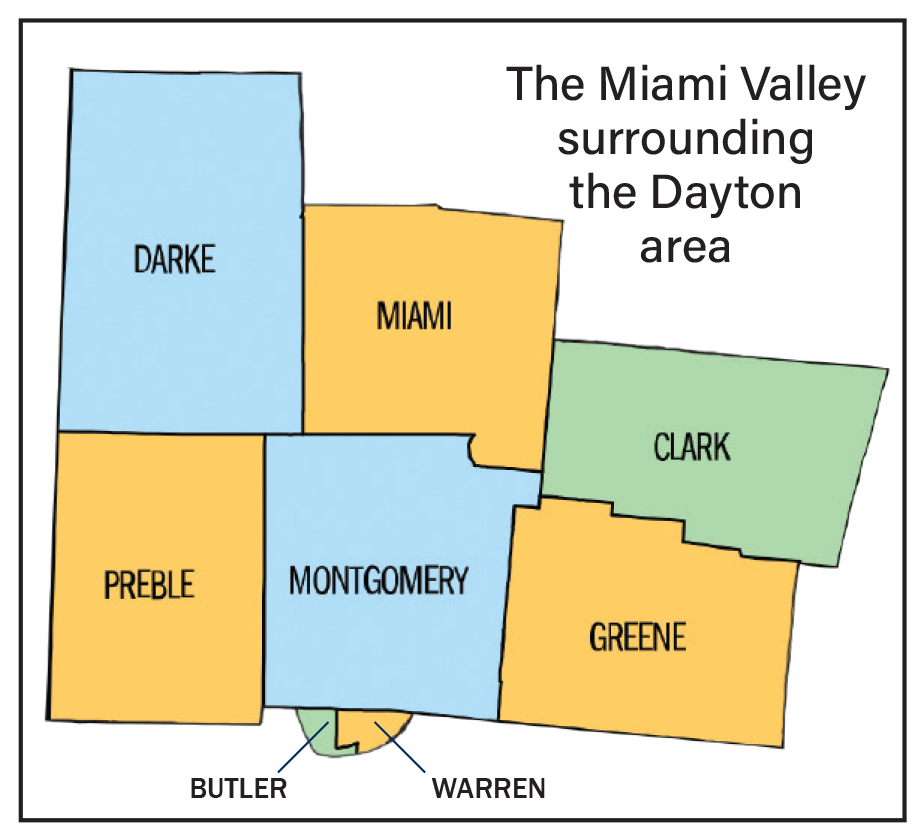
The Jewish Federation of Greater Dayton defines its catchment area across the Miami Valley as comprising Montgomery, Greene, Miami, Clark, Darke, and Preble Counties, and the northernmost parts of Butler and Warren Counties.
Sheskin’s latest estimate of Jews in these counties and sections of counties totals 7,038:
• Montgomery: 5,000
• Greene: 800
• Miami: 500
• Clark: 350
• northernmost Warren: 240
• northernmost Butler: 128
• Darke: 10
• Preble: 10
He also estimates 6,000 Jews live in Ohio’s 10th congressional district, which comprises Montgomery and Greene Counties and part of Clark County.
For Jewish communities that have not conducted a scientific population study in more than a decade such as the Dayton area, Sheskin employed what he calls the “New Multimethod Distinctive Jewish Names-Guided” estimates.
It’s combines the long-accepted use of a multiplier based on distinctive Jewish surnames with address-based sampling from national household directories, estimated data from Pew Research Center’s 2020 survey, and Brandeis University’s 2020 American Jewish Population Project Estimates.
Sheskin’s revised method factors in information provided by professional leaders of local Jewish communities, from synagogues and other Jewish institutions, and census data.
“We’ll never know the right numbers. The first rule in social science is, if you want to count something, you have to define it. And until the Knesset (Israel’s parliament) can tell me who’s Jewish, that’s a problem,” Sheskin quipped.
He said his increased Jewish population estimate for the Miami Valley is less about growth and more about previous undercounting in the absence of research funding.
“As you can imagine, it took hundreds of hours,” he said. “It was eight months of work. It was a tremendous amount of work.”
Along with his staff, Sheskin worked with the authority on surnames at the U.S. Census Bureau.
Despite an increase in intermarriages in the U.S., 8-12% of U.S. Jews continue to have one of 36 distinctive Jewish names, Sheskin said.
For this study, Sheskin cut six of the surnames from the list because in some parts of the country such as Ohio, a high percentage of people with those names aren’t Jewish.
He verified Jewish identities beyond reliance on surnames, checking obituaries and other local sources to avoid counting non-Jewish people with traditional Jewish surnames.
One name he cut, for example, was Schwartz.
“Now, in a place like Miami or Brooklyn, probably almost every Schwartz is Jewish. But not in a place like Ohio, Wisconsin, the Dakotas, with large German populations. We picked 30 that we felt were good hits for Jews and not for Germans.”
A name that is on the list of 30 that proved a challenge in the Miami Valley was Grossman.
“There were too many Grossmans in your area,” Sheskin said. “Too many of the Grossmans are probably not Jewish, so I pulled them out. And seven Siegels from the total. You should have a lot of Cohens and a lot of Levys. Those should be among the top. I know from looking at select phone lists from the entire country at these 30 names, 11% of these 30 names are Cohens. So we don’t just use the (local) counts.”
Sheskin said of his 2025 American Jewish Yearbook estimates, based on his Jewish Electorate Institute study, “The only thing we can be sure of in terms of these numbers is that every single one of them is wrong.”
What gives him confidence in his data is its similarity to Pew and Brandeis’ 2020 findings.
“The Pew 2020 came up with 7.5 million Jews. The (Brandeis) American Jewish Population Project came up with 7.6 million Jews, and the 2025 American Jewish Yearbook has 7.7 million Jews,” Sheskin said.
“I’m sure they’re all wrong, but we have what’s called convergent validity. We have three methods. Ain’t none of them good, but they all basically came out with the same number.”
Related: The 30 names that help pollsters find U.S. Jews
To read the complete April 2026 Dayton Jewish Observer, click here.