
Israeli Yair Horn’s testimony of 498 days in Hamas captivity
‘To be a hostage does not define me’
By Marshall Weiss, The Dayton Jewish Observer
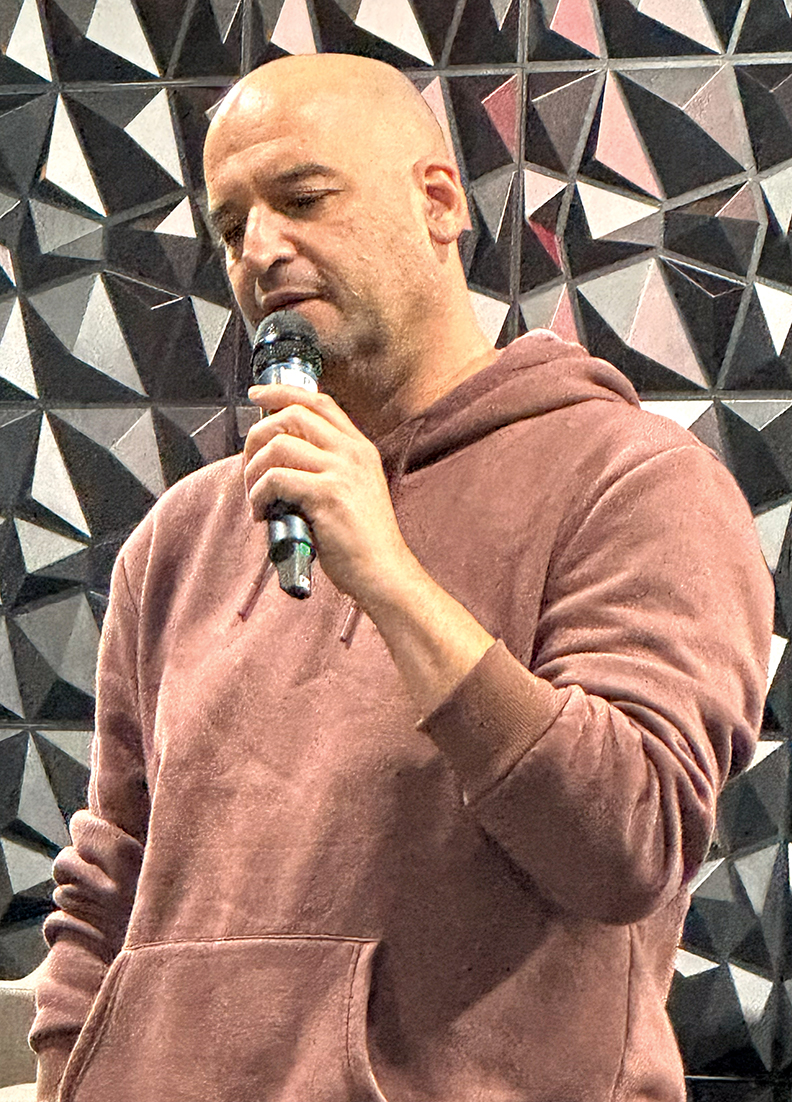
“I told myself that I’m a dead man. So every second, every minute, every hour, every day, it will be a gift. So that was my technique. And you never lose the hope. You cannot,” Yair Horn shares with an audience Jan. 14 at the Pentecostals of Dayton Church Center, of his mindset over the 498 days he languished in Hamas captivity after his abduction Oct. 7, 2023 from Kibbutz Nir Oz.
His talk in Dayton was presented by Christians United for Israel, an evangelical Christian organization that advocates and raises funds for the Jewish state. Pentecostals of Dayton’s pastor, Wylie Rhinehart Jr., was recently named CUFI’s coordinator for Ohio.
“Kibbutz Nir Oz is near the Gaza Strip. From my porch, you can even see the first village in Gaza,” says Yair, who was the first of his family to make aliyah (immigrate to Israel) from Argentina and has lived on the kibbutz since 2014. Nir Oz was home to about 420 people.
“That 7th of October began almost like a regular morning for me because we had the first red alert, which is the alarm we hear when the terrorists shoot off rockets,” he says. “Sadly, once or twice a year, we have what we call ‘little drops of rain,’ which is the rockets.”
His safe room was also his bedroom. Yair’s brother Eitan was visiting him that morning and joined him in the safe room.
“A few minutes after that, we get the first message from the kibbutz that we have Hamas terrorists inside the kibbutz wearing IDF uniforms. A few minutes after, I start to hear shootings and shouts in Arabic. A few minutes later, they come into my house, and they tried to open the door of the safe room.”
The safe room, designed to withstand missiles, has no lock. Yair held the handle and struggled to keep them from getting through twice.
“The third time, they start to shoot with the machine gun, an AK-47, and my brother was sitting on the side. He was petrified. The first four or five bullets went like half an inch from my brother. When I told him to move to another corner of the safe room, they shoot again.”
Yair opened the door and came out with his hands up, to give his younger brother time to hide or get out by the window.
“Maybe they just shoot me in the face. I didn’t know. I open the door and four or five Kalashnikovs are pointing at me. They take me a few meters to a motorcycle. Three minutes on the motorcycle and we were in the Gaza Strip. Every half a mile or a mile, they would stop the motorcycle and shout, ‘Yahood! Yahood (Jew)! We have a Yahood!’ A bunch of people came and punch me, punch me, punch me, punch me. Another mile we drive, they stop, shout ‘Yahood! Yahood!’ A lot of people came to punch me, punch me — several times, three, four times until they take me to a house. From that house, they take me down to the tunnels. I didn’t see the sunlight for almost 500 days. I didn’t have fresh air to breathe for almost 500 days.”
At Kibbutz Nir Oz that day, more than 500 Hamas terrorists murdered 47 people and took 76 hostages. Twenty-two hostages from Nir Oz would be killed or die in captivity. The kibbutz itself was all but destroyed.
After a few weeks, Yair was kept with his brother Eitan. Before that, neither knew if the other had survived. “We looked at each other’s faces and decided without talking we’re not telling them we are brothers,” Yair said. “Why? Because we were afraid they can think, ‘We have two from one family, we can shoot one.'”
Yair also withheld from his captors that he was diabetic. “The first day when they kidnapped us, the terrorists wanted to give me chocolates and candies because when you’re in a panic situation you need sugar in order to not fade out,” he said. “I know that I should not eat chocolate, candies. But the first hours, I ate chocolate because I didn’t want to tell them that I’m sick, that I will be problematic. Maybe they’ll shoot me in the face if they know I have sugar problems. You actually need to think maybe three or four times before you talk or before you do something because you don’t know the consequences.”
Yair says he lost 70 pounds in captivity. He had no access to cigarettes, so he’s no longer a smoker. And he left his diabetes in the tunnels.
“And because of the lack of sun, my skin looks like a baby. I look like an Italian model right now. If you want to get to a good spa, you can go to the Gaza Strip, to the Hamas spa,” he quips.
Humor, Yair says, helped him and Eitan get through. “In my family, we have a very stupid sense of humor. And with my brother, we decided at some point that if we’re going to die, at least we will try to laugh or even make life better.”
But showing humor, he says, was also a gamble. “The people are terrorists. They hate me because I’m a Jew. They hate me because I’m living in Israel. They are radical terrorists. They are not crazy, because crazy people don’t know most of the time what they are doing. These people know exactly what they are doing.”
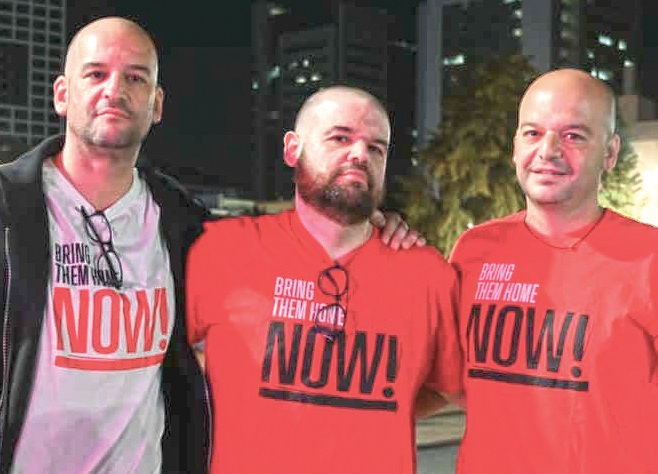
His captors gave his group of five people barely enough food and water to survive. They slept on the floor for a few months.
“The tunnels have organized places with rooms and a kitchen, even a bathroom,” Yair says. “They also moved us a few times. We didn’t know where we were exactly. And when the IDF bombed a few zones, we started to run through the tunnels. Can you imagine? In that situation, I need to trust in the same man that kidnapped me, in order to not get killed by mistake.”
The vast maze of tunnels, Yair says, had explosives throughout.
“They told us that if the IDF comes to rescue us, ‘we’ll just blow up everybody.’ My group, behind bars, would sleep next to an explosive mine.”
The room had a small LED lamp. When the terrorists would turn it on, it meant they were coming, possibly with food. “Every time they turn on that light, I started like a dog to salivate and get anxious. Like an animal.”
That the hostages never knew what their captors put in their food and drinks weighed heavily on them.
When Yair would try to eat with his dominant hand, his left, the captors would slam it and take his food away. “It’s part of the Islamic tradition to eat just with the right hand.”
Though he can’t be certain, he thinks he received better treatment than the others in his group because Yair is in his mid-40s.
“In Islam, they have the tradition of respect the elders. And in my room, I was the oldest. I was also older than the terrorists. They never beat me after that (the beatings on the streets). A couple of times, I even get a coffee. In captivity, in order to survive, you try to generate empathy or to empathize with the terrorists.”
Yair decided not to calculate the days and months while he was held captive. “I love being with my family and it would be worse if I know there is the New Year and I’m not with my family,” the self-described secular Israeli says.
The worst day of his captivity was his last: Feb. 15, 2025. He and two other hostages were released as part of the sixth round of swaps for terrorists imprisoned in Israel.
“It was the day I left behind my little brother. The last day, before they take me out, they came to our group and they told us that just two of us get released. But they make us believe that we can choose who’s going: everyone with his own problem or disease.”
Once freed, Yair tirelessly advocated to get his brother and the remaining hostages out. Eitan went home Oct. 13, 2025 with the last 20 living hostages as part of the ceasefire deal. He endured 738 days in captivity.
Should it bother us that some Christian Zionists believe we’re not saved?
Established by San Antonio-based Pastor John Hagee 20 years ago, Christians United For Israel now has 10 million members across the United States.
Its January event with former Israel hostage Yair Horn was its first in the Dayton area since 2019’s Dayton Night to Honor Israel at the Victoria Theatre. CUFI hosted three Dayton Night to Honor Israel events before that: in 2015 at the Schuster Center, and in 2016 and 2018 at Temple Beth Or.
Since Oct. 7, 2023, the evangelical Christian Zionist CUFI and its partner ministries have raised more than $11 million to fund equipment for first responders in Israel and assist Israelis forced out of their homes in the north by Hezbollah rocket attacks.
At the Dayton program, CUFI National Field Director Randy Neal addressed head-on a concern that made area Jews uncomfortable at past Dayton CUFI events: speakers’ disparaging statements about Arabs and Muslims.
“You know, being pro-Israel is never synonymous with being anti-Arab or anti-Muslim,” he told the audience.
Neal addressed another issue that’s been a concern to some Jews, to the extent he was able.
“Yair (a secular Jew) knows that I believe Jesus is the Messiah. He also knows that he doesn’t have to agree with me theologically before I will stand with him, and hope that he’ll be able to connect those dots.”
As a matter of policy, CUFI doesn’t proselytize. At the same time, some though not all in its evangelical base believe Jews won’t be saved unless they accept Jesus Christ as their lord and savior.
At a time when Jews and Israel need all the friends they can get, some American Jews are grateful for CUFI’s support and shrug off any concerns with a stance of, “We’ll find out when we get there.” But not all.
An example unrelated to the CUFI event was delivered Jan. 4 in the Greenville Early Bird weekly newspaper.

With the headline How does God feel about Israel and Jews, Pastor Timothy Johnson of Countryside Baptist Church in Parke County, Ind., wrote: “Yes, Jesus is the only means of salvation, and many Jews do not have everlasting life because of their rejection of Christ, but the fact remains that God is true to His promises. He blesses those who bless Israel and He curses those who curse her…Regardless of their rejection of His Son thus far, He plans to bring them to faith in Christ en masse someday. There is not an ounce of antisemitism in His heart.”
One Jewish reader in Greenville told The Observer, “As one of less than 10 Jews in the county (Darke), I appreciate that some people are supportive of Israel and recognize that Jesus was Jewish, and I’ve felt less antisemitism here than in New York, where I grew up in a very mixed neighborhood. But it was still very uncomfortable.”
University of Dayton Prof. of History and Religion William Trollinger said Johnson expressed standard fundamentalist theology about the Jews.
“That is, all people are consigned to hell unless they confess Jesus as their savior,” Trollinger said. “He’s holding to a dispensational theology, that Jesus will return at the end of time and call up the true Christians and they go up in the air. And then there will be what is called the seven-year tribulation period in which the world is ruled by an Antichrist. Midway through the tribulation, the Jews will realize that Jesus is the messiah and they will convert and so they won’t be condemned.”
Trollinger added that this isn’t universal Christian theology. “That said, millions and millions of people hold to this. Evangelicals are seen, according to polling data, as the strongest supporters of the State of Israel, stronger than (American) Jews. You can be a very strong supporter of the State of Israel and still feel that all Jews who do not convert are going to be sent to eternal hell.”
When asked if Jews can only be saved if they accept Jesus, Pentecostals of Dayton Pastor Wylie Rhinehart Jr., CUFI’s new coordinator for Ohio, declined to comment.
Rhinehart did say, “We love the Jewish nation, the Jewish people. They have our full support.”
To read the complete February 2026 Dayton Jewish Observer, click here.