
From Dolly to designer genes
In the news — a series
Jewish Family Education with Candace R. Kwiatek, The Dayton Jewish Observer
2018: The CRISPR Bombshell was the headline of a New Scientist article, followed by the lede, “He Jiankui shocked the world last week when he announced the birth of two gene-edited girls.” To make them resistant to HIV, the Chinese researcher had altered the embryonic twins’ DNA using CRISPR, a technique likened to “molecular scissors” that allows for a cut-and-paste approach to gene editing described as “fast, easy, and cheap.” Labeled the “Chinese Frankenstein,” Jiankui was globally condemned for unethical human experimentation.
2020: CRISPR genome editing gets 2020 Nobel Prize in Chemistry, Chemical and Engineering News announced. Fyodor Urnov, renowned as a pioneering figure in the field of genome editing, noted, “The number of discoveries in biomedicine that have had (this) impact…can be counted on the fingers of one hand…We have never had a technology as powerful and versatile as genome editing with CRISPR.”
2025: Genetically Engineered Babies Are Banned. Tech Titans Are Trying to Make One Anyway, reported the Wall Street Journal. Although still in its early preclinical research stage, startup Preventive has reportedly identified an interested couple and possible offshore sites for pursuing human embryo gene editing to prevent severe genetic diseases.
But law and bioethics professor Hank Greely warns, “Once you start editing embryos, you’re not just treating a patient — you’re changing the human species.”
In just under 30 years, genetic engineering technologies have evolved dramatically, from cloning of adult cells’ DNA, popularized by Dolly the sheep (1996), to reprogramming of adult cells into embryonic-like multiuse stem cells (2007), to CRISPR gene editing after birth for the treatment of serious medical conditions (2019).
Today’s rapidly multiplying biotech companies, following in Jiankui’s maverick footsteps, are continuing this evolutionary trend.
Like Preventive, some startups are looking to eliminate disease through embryonic gene-editing, while others aim to use it for enhancing desirable traits, from stronger hearts and bones to higher IQs.
Twelve IVF startups are now using polygenic embryo screening to predict traits and disease risks, or offering genetic optimization tools, allowing parents to select embryos with traits they desire, the controversial realm of designer babies.
But embryonic gene-editing and genetic optimization are not as avant garde as you might think. According to bioinformatics specialist Matthew Cserhati, one of the earliest appearances of applied genetics — that is, the practical use of genetic principles — is recorded in Gen. 30–31, which describes Jacob’s sheep breeding program.
When Jacob’s father-in-law Laban appropriated all the speckled and spotted sheep and goats and every dark-colored lamb previously promised to Jacob as wages, the skilled shepherd immediately rallied.
Using animal stanchion posts made from branches and strategically placing them in the watering troughs, Jacob selectively bred the remaining white animals to produce speckled, spotted, and dark-colored livestock for himself, creating large herds and becoming exceedingly prosperous.
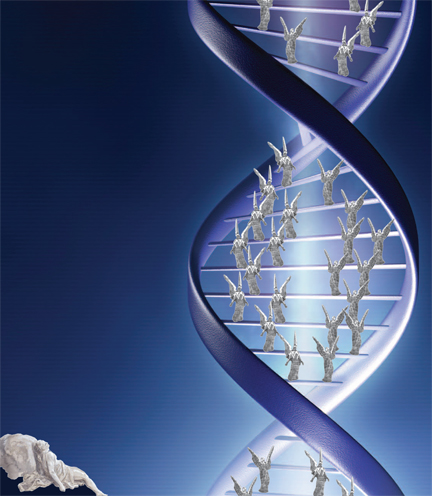
Jacob’s story suggests that genetic engineering at some level is allowed in Judaism, but “its application in humans leads to all sorts of ethical, moral, and halachic (Jewish legal) dilemmas,” Rabbi Yehuda Shurpin explains. “There is considerable debate regarding (its permissibility in humans) and, if it is permitted, what its parameters are.”
Three principles gleaned from a classic Jewish text provide a strong foundation for identifying the issues and exploring solutions.
A midrash on the Book of Ecclesiastes reads, “When the Blessed Holy One created the first human, He took him and led him round all the trees of the Garden of Eden and said to him: ‘Look at My works, how beautiful and praiseworthy they are! And all that I have created, it was for you that I created it. Pay attention that you do not corrupt and destroy My world: if you corrupt it, there is no one to repair it after you.”
Divine ownership/humility. “The first important message in this story is the principle of Divine ownership,” Rabbi David Rosen notes, an idea more clearly expressed by God in Leviticus: “For the earth is mine and you are sojourners and temporary residents in it with me.”
The realities of not being earth’s creators, lacking knowledge of all its intricacies, and residing on it only briefly are arguments for humanity’s humility rather than arrogance.
Humanity is a partner with God in creation/purpose. “The second idea that emerges from this midrash,” Rosen continues, is “that humanity is actually a partner with God in the Creation (with) the ability to maintain, sustain, and improve our world, as well as the capacity to destroy it.”
Researcher Akiva Wolff notes that a midrash about Rabbi Akiva, who demonstrates the superiority of man-made bread over the Creator’s raw wheat kernels for a Roman soldier, signifies that “Man is permitted, and sometimes commanded, to alter nature in order to perfect the works of the Creator.”
Having been divinely-ordained as God’s partner in Creation for the purpose of improving the world, humanity should proceed with caution and reverence.
God gives humans dominion over the earth/accountability. “Thus we come to the third of the principles contained in our midrash,” Rosen remarks, humanity’s dominion over Creation.
Intended as a mandate for responsible and benevolent stewardship — not tyranny, unlimited exploitation, or radical anthropocentrism that serves only human interests — humanity will ultimately be accountable for how its dominion is used.
To paraphrase Stephen Hawking, “If we can edit our genes, what’s to stop us from redesigning our species?”
Quote collector Allison Dunn adds, “Once the tool exists, the question isn’t ‘if’— it’s ‘how far.’”
Humanity’s sense of humility, purpose, and accountability will in large part determine the answer.
Next month: Judaism and transhumanism.
Literature to share
A Story for Everything: Mastering Diverse Storytelling for Any Occasion by Corey Rosen. People never forget a good story. In this practical but fun guide, learn how to structure stories effectively and what techniques create audience engagement. Transform real-life experiences into clever anecdotes or short stories for work, school, and family settings. Explore storytelling styles for different occasions, from birthdays to job interviews. And much more. Hot off the press, this self-help gem is an entire workshop between two covers.
Mendel the Mess-Up by Terry LaBan. Mendel believes he’s cursed! Everything he tries turns into a disaster, so everyone in his little village begins calling him Mendel the Mess-Up. That is, until the Cossacks invade. Fast-paced, funny, and boldly illustrated, this graphic novel for middle grades incorporates a little bit of Chelm, a bit more of history, and ultimately reminds readers that sometimes our weakness can be our greatest strength.
To read the complete January 2026 Dayton Jewish Observer, click here.